
How much fabric for tablecloth projects comes down to one decision before any math happens: how far you want the fabric to hang over the edge. According to Wikipedia, a tablecloth’s overhang, known as the drop, typically runs 6 to 15 inches on each side, with a shorter drop suited to casual dining and a longer drop reserved for more formal occasions. This guide covers the formula for rectangular, square, and round tables, plus what changes when your table is wider than a single width of fabric.
Table of Contents
Quick Answer
For a rectangular or square tablecloth, add your chosen drop length twice to both the table’s length and width, plus a small hem allowance, then convert the total to yards. For a round tablecloth, add the drop twice to the table’s diameter instead. A standard 6-foot rectangular table with a 10-inch drop needs a finished tablecloth of about 88 by 50 inches, which comes to roughly 2.5 yards on wide enough fabric.
Choose Your Drop Length First
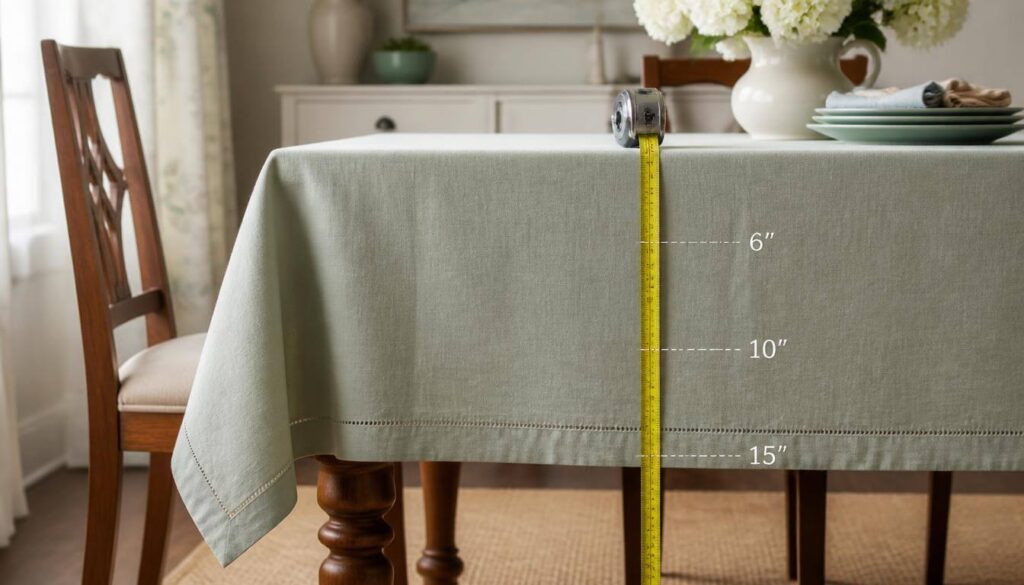
The drop is everything the math below depends on, so it’s worth deciding this before you measure anything else. A 6 to 12-inch drop suits everyday dining and gives enough room for chairs to tuck in comfortably. A 15-inch drop reads as more formal, and a floor-length drop is generally reserved for weddings or special events where the tablecloth is meant to fully cover the table’s legs.
How Much Fabric for a Rectangular or Square Tablecloth
Step 1 — Calculate Finished Tablecloth Size
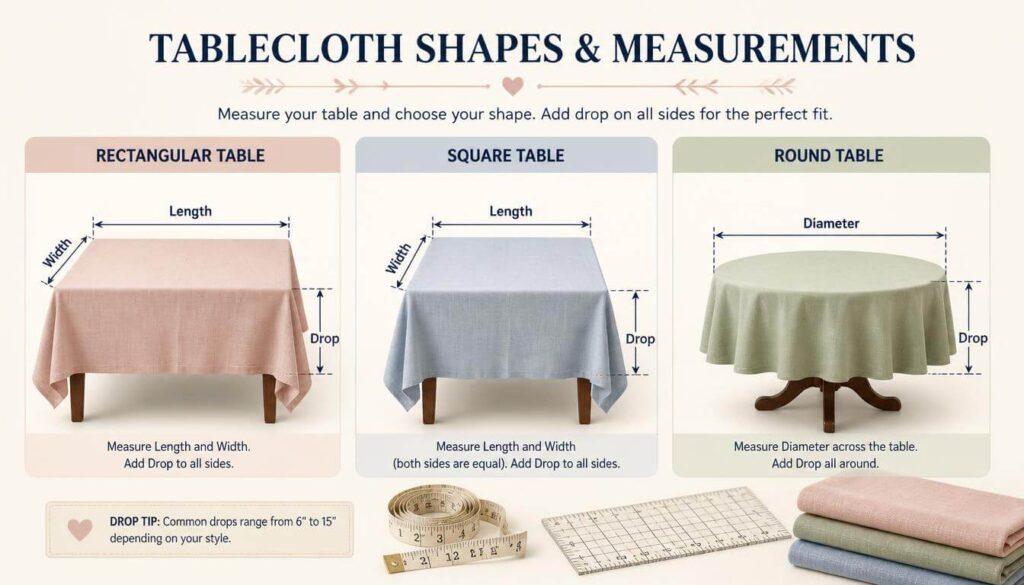
Add your chosen drop to both sides of the table’s length and both sides of its width.
Finished length = table length + (drop × 2) Finished width = table width + (drop × 2)
For a 30 by 72-inch table with a 10-inch drop, that’s a finished tablecloth of 50 by 92 inches.
Step 2 — Add Hem Allowance
Add a small hem allowance on top of the finished size roughly 1 inch for a narrow rolled hem, or up to 4 inches if you want a wider, more substantial hem finish. Some fabrics, like oilcloth or laminated cotton, don’t need a hem at all and can skip this step.
Step 3 — Check If You Need to Seam Fabric Widths Together
If your fabric’s usable width is narrower than your tablecloth’s finished width, you’ll need to join two or more widths with a seam down the middle, or split evenly on either side of a center panel. Divide your finished tablecloth width by your fabric’s usable width and round up to the next whole number to see how many widths you need.
Step 4 — Convert to Yards
Multiply the number of widths needed by your finished tablecloth length, then divide by 36 to convert to yards, rounding up to the nearest quarter yard.
(Number of widths × finished length) ÷ 36 = total yards
How Much Fabric for a Round Tablecloth
Round tablecloths use the same drop concept, but applied to the table’s diameter instead of its length and width separately.
Finished diameter = table diameter + (drop × 2)
A 60-inch round table with an 8-inch drop needs a finished tablecloth diameter of 76 inches. Since a round cloth is generally cut from a square piece of fabric, treat your finished diameter as both the length and width when calculating yardage, following the same seaming and conversion steps above.
How Much Fabric for Tablecloth Projects: Quick-Reference by Table Size
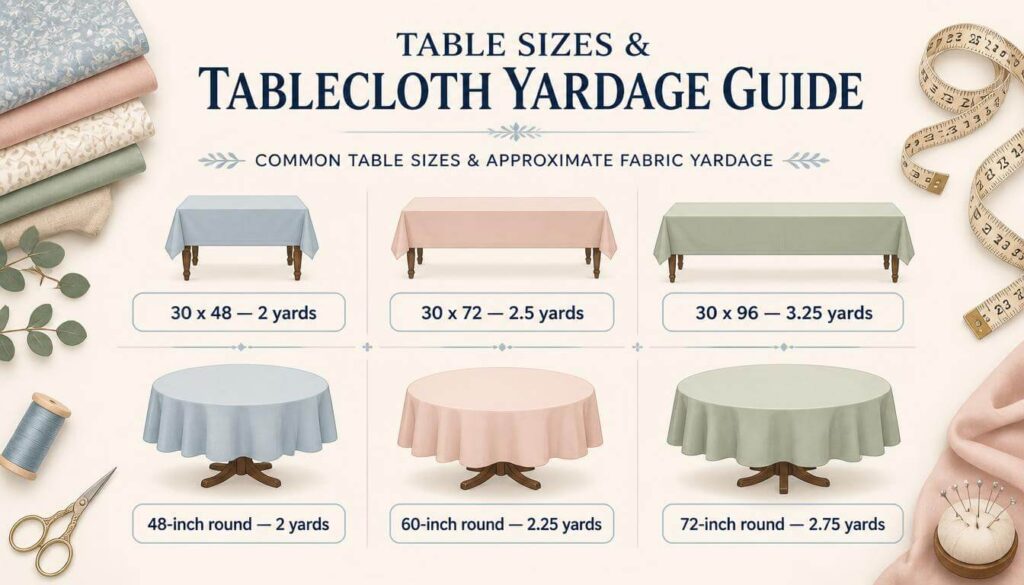
These figures assume a 10-inch drop and fabric wide enough to avoid seaming, rounded up to the nearest quarter yard.
| Table Size | Finished Tablecloth Size | Approximate Yardage |
|---|---|---|
| 30 x 48 in (small rectangular) | 50 x 68 in | 2 yards |
| 30 x 72 in (standard 6 ft) | 50 x 92 in | 2.5 yards |
| 30 x 96 in (8 ft banquet) | 50 x 116 in | 3.25 yards |
| 48 in round | 68 in diameter | 2 yards |
| 60 in round | 80 in diameter | 2.25 yards |
| 72 in round | 92 in diameter | 2.75 yards |
Adjusting for a Pattern Repeat
If your fabric has a repeating print and you need more than one width seamed together, add one vertical pattern repeat to your total length for each extra width beyond the first. A tablecloth needing two widths with a 27-inch vertical repeat, for example, adds a full 27 inches on top of the base calculation so the pattern lines up across the seam.
Common Mistakes to Avoid
- Choosing a drop length after buying fabric instead of before, which can leave you short on width
- Forgetting to add the drop twice once for each side of the table rather than just once
- Not checking whether your fabric width requires seaming before finalizing your yardage
- Skipping the pattern repeat adjustment when joining multiple fabric widths
- Assuming a round table needs less fabric than a rectangular one of similar size, when the diameter calculation often uses more
FAQs
How much fabric do I need for a 6-foot table tablecloth?
A standard 30 by 72-inch table with a 10-inch drop needs a finished tablecloth around 50 by 92 inches, which comes to roughly 2.5 yards on fabric wide enough to avoid seaming.
How do I calculate fabric for a round tablecloth?
Add your chosen drop twice to the table’s diameter to get your finished tablecloth diameter, then treat that number as both dimensions when calculating yardage, since round cloths are typically cut from a square piece of fabric.
What’s a standard tablecloth drop length?
A 6 to 12-inch drop suits everyday dining, while 15 inches reads as more formal. Floor-length drops are generally reserved for weddings or special events rather than everyday use.
Do I need to seam fabric together for a large tablecloth?
Only if your fabric’s usable width is narrower than your tablecloth’s finished width. Divide your finished width by the fabric’s width and round up to see how many widths you’ll need to join.
Does a patterned fabric need extra yardage for a tablecloth?
Yes, if you’re seaming multiple widths together. Add one full vertical pattern repeat to your total length for each additional width beyond the first, so the design lines up across the seam.
Conclusion
Once you’ve settled on a drop length, calculating how much fabric for tablecloth projects you need becomes a straightforward formula, whether your table is rectangular, square, or round. The details that catch people out seaming for wide tables and adjusting for a pattern repeat are exactly the ones a flat “buy this many yards” estimate tends to miss.
For a general refresher on the base yardage formula this builds on, see our pillar guide on how much fabric do I need, or skip the math with the SewSmartHub fabric yardage calculator.