

What do sewing machine needle numbers mean? Every pack carries a pair of them, like 80/12 or 90/14, and they look like a code. They’re actually two ways of describing one thing: how thick the needle is.
This guide decodes both numbers, shows you a conversion chart, and walks through the rest of the label, including the system code and the colored bands. If you already know how to read a pack and just need a size for your fabric, our guide on what size sewing machine needle to use is the better starting point.
Table of Contents
Quick Answer
What do sewing machine needle numbers mean, in short? The two numbers on a needle pack, such as 80/12, are the same size written in two systems. The first is the metric (European) size, which is the needle’s thickness in hundredths of a millimeter, so 80 means 0.80 mm. The second is the American size, a separate scale that happens to line up with it.
A bigger number means a thicker, stronger needle with a larger eye. A smaller number means a finer needle for lightweight fabric and thinner thread.
What Do Sewing Machine Needle Numbers Mean? The Two Numbers on Every Pack
Think of the slash as an “equals” sign. A pack marked 80/12 is a single needle, and 80 and 12 are two labels for its thickness.
The Metric (European) Number
According to Wikipedia, the metric designation is the actual needle diameter in hundredths of a millimeter. That’s why an 80 needle measures 0.80 mm across, and a 100 needle measures a full 1.00 mm.
You may also see this number written as “Nm” or “NM” on packaging. It stands for the metric number, and it’s the one most guides lead with because it’s a real measurement.
The American Number
The American number comes from a different, older scale that Singer helped spread. It isn’t a direct measurement. It’s a running sequence, so 8, 9, 10, 11, 12 and so on climb as the needle gets thicker.
Because the two scales were built separately, they don’t share a neat formula. You simply pair them: 80 goes with 12, and 90 goes with 14.
Many sewists overlook how handy this is when shopping abroad. A European pack may print only “80,” and you can read that as an 80/12 without guessing.
Sewing Machine Needle Size Conversion Chart
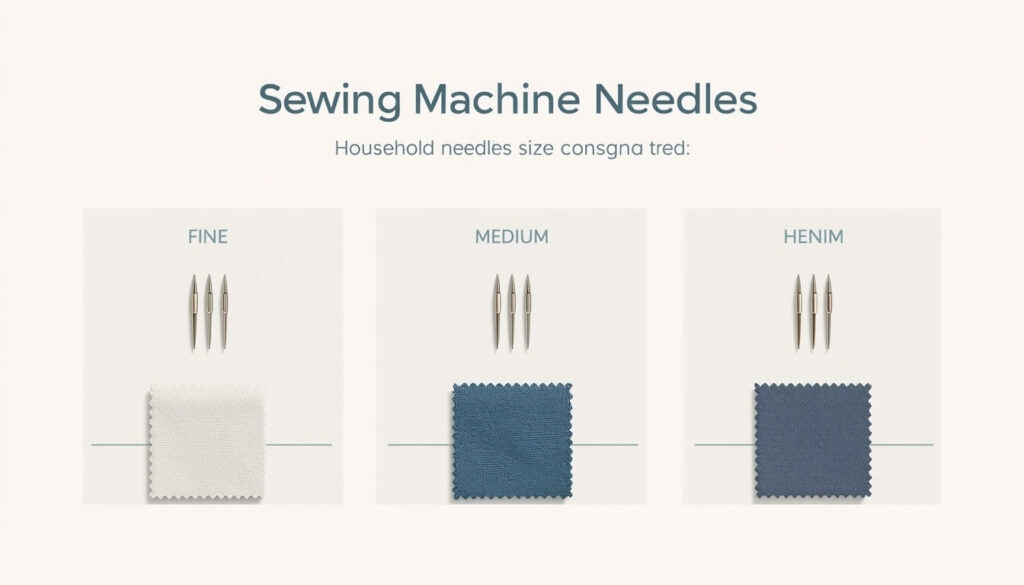
What do sewing machine needle numbers mean in real measurements? Save this chart. It matches the metric and American sizes you’ll see on most home-machine needle packs, with the actual diameter in millimeters and inches.
| Metric (EU) | American (US) | Diameter (mm) | Diameter (in) | Feels Like |
|---|---|---|---|---|
| 60 | 8 | 0.60 | 0.024 | Very fine |
| 65 | 9 | 0.65 | 0.026 | Very fine |
| 70 | 10 | 0.70 | 0.028 | Fine |
| 75 | 11 | 0.75 | 0.030 | Fine to medium |
| 80 | 12 | 0.80 | 0.031 | Medium |
| 90 | 14 | 0.90 | 0.035 | Medium to heavy |
| 100 | 16 | 1.00 | 0.039 | Heavy |
| 110 | 18 | 1.10 | 0.043 | Very heavy |
| 120 | 19 | 1.20 | 0.047 | Extra heavy |
Heavier sizes continue beyond this table, and Wikipedia lists a 130 needle at 1.30 mm (American 21). Most home sewing never goes past 110/18.
Here’s a quick example. Say you’re holding a pack of 100/16 and a pack of 90/14. The 100/16 is the thicker needle by 0.10 mm, which is why it’s the stronger pick for denim.
How to Read a Needle Package, Line by Line
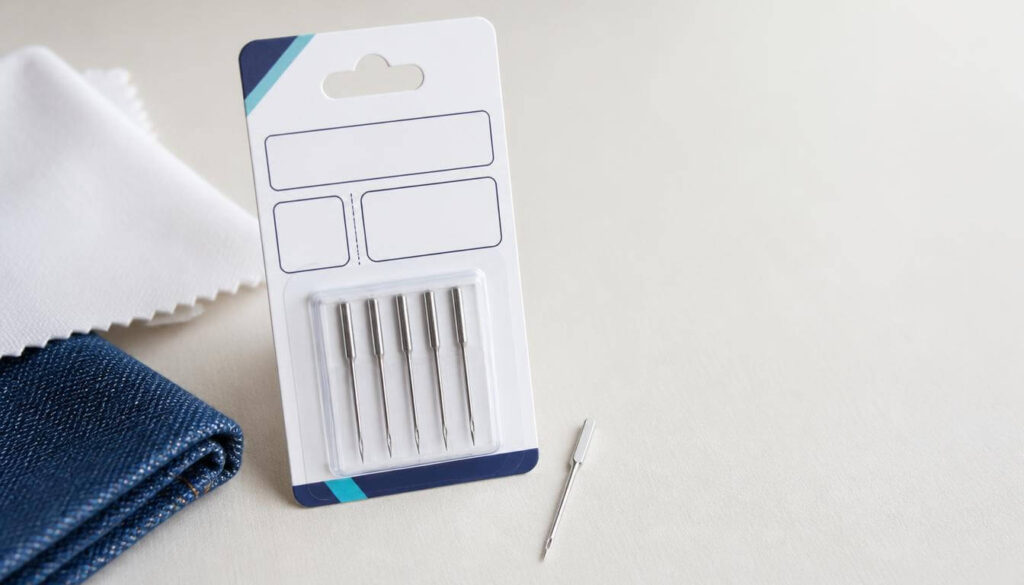
So what do sewing machine needle numbers mean once you step back to the full label? The size is only one line. Schmetz, a major needle maker, explains in its guide to reading the needle package that the label shows size, system, and type.
Size
The size sits at the bottom of the package and shows both numbers, metric and American. Assorted packs list several, such as 70/10, 80/12, and 90/14, so you can switch weights without buying three packs.
Needle System (130/705 H)
The system code tells you what the needle’s shank looks like, and whether it fits your machine. The code 130/705 H describes a flat shank with a scarf, and Schmetz notes that nearly all home sewing machines use it. The “H” comes from a German word for scarf, the groove behind the eye.
You may also see 15×1 on the pack. That’s a cross-reference to the same system from another maker. For the full compatibility picture, see whether sewing machine needles are universal.
Needle Type
The type tells you the point and the job. Schmetz makes 16 needle types for home machines, including universal, ballpoint, jeans, and quilting.
Take a pack that reads 90/14, 130/705 H, Jeans. The 90 and 14 are the thickness, 130/705 H confirms it fits a household machine, and Jeans tells you it’s built for woven denim.
What Do the Colored Bands on Needles Mean?
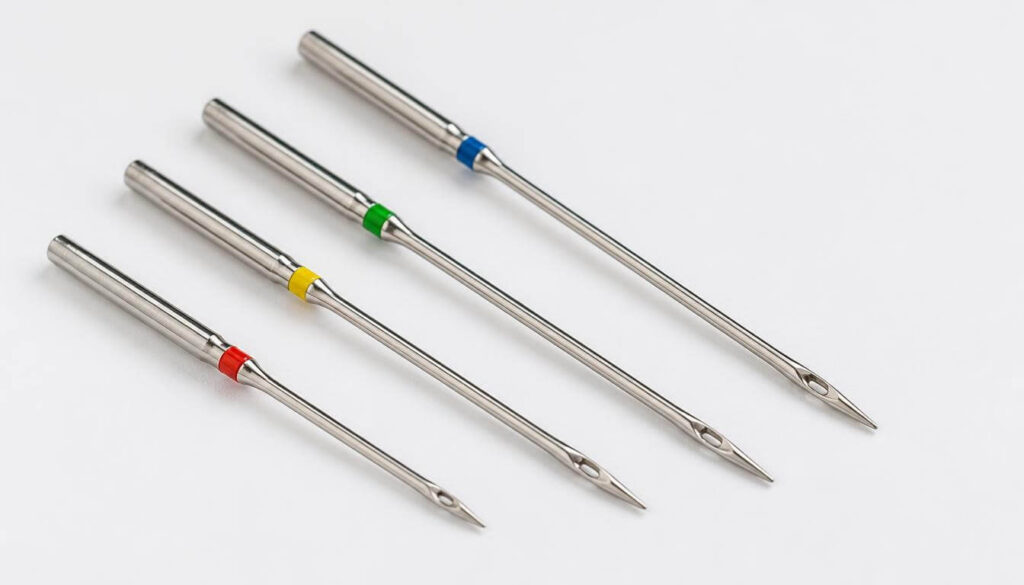
Some needles carry colored bands on the shoulder, just below the shank. On Schmetz home needles, the top band shows the needle type and the lower band shows the size, according to the company’s color-coding chart.
There’s one exception. Universal needles carry just one band, which shows the size. The type needs no color because universal is the default.
Here’s the part most guides skip. Colors aren’t a universal language. Different brands use different codes, and even one brand has changed its colors over time. Wikipedia notes that Singer, Kenmore, and Schmetz each use their own color systems, and Kenmore’s colors indicate size rather than type.
So don’t memorize a color chart. Read the printed label on the pack, and use the bands only as a quick cross-check against the same brand’s chart.
Does a Bigger Number Mean a Better Needle?
No. What do sewing machine needle numbers mean about quality? Nothing, because a bigger number only means a thicker needle. It’s better for some fabrics and worse for others.
A thicker needle has a stronger shaft and a larger eye, so it handles heavy fabric and thick thread. But it also punches a bigger hole. On delicate cloth, that hole shows.
A real scenario: someone puts a 110/18 needle into a chiffon scarf because they think “stronger is safer.” The needle leaves visible holes along the seam. A 60/8 or 70/10 would have sewn it cleanly.
Pick the finest needle that sews your fabric without bending or skipping. For the exact size by fabric, use our needle size chart. If needles keep snapping even at the right size, see why a sewing machine needle keeps breaking.
Why Hand Needle Numbers Work the Opposite Way
Hand-sewing needles use a different scheme, and it trips people up. On hand needles, a higher number generally means a finer, shorter needle, so a size 10 is thinner than a size 5.
Machine needles run the other way. A bigger number means a thicker needle. If you move between hand sewing and machine sewing, keep the two scales separate in your head.
Once you’ve picked the right machine needle, swapping it in is quick. Our guides on how to change a sewing machine needle and how to insert a sewing machine needle cover the steps.
Common Mistakes to Avoid
- Treating the two numbers as separate needles instead of one needle in two scales
- Assuming a higher number is always better, regardless of fabric
- Relying on needle color alone to identify the type or size
- Confusing hand-needle sizes with machine-needle sizes
- Ignoring the system code and buying by size only
- Buying a pack that prints a single metric number and guessing at the American size
FAQs
What does 80/12 mean on a sewing machine needle?
It means the needle is 0.80 mm thick, written in both the metric (80) and American (12) systems. It’s a medium size, and it’s the common all-purpose choice for quilting cotton, shirting, and similar medium-weight woven fabrics. If you’re unsure what to buy, 80/12 is a safe default.
Why do sewing machine needles have two numbers?
Two sizing systems exist, one metric and one American, and packs print both so every sewist can read them. The first number is metric, the second is American, and they describe the same needle thickness. The metric number is the real measurement in hundredths of a millimeter.
Is 100/16 thicker than 90/14?
Yes. A 100/16 is 1.00 mm thick and a 90/14 is 0.90 mm thick, so the 100/16 is the heavier, stronger needle. That makes it a better fit for denim and canvas, while 90/14 suits medium-heavy fabrics like twill and corduroy.
What does the H mean on a sewing machine needle?
In the code 130/705 H, the H stands for a German word meaning scarf, which is the groove behind the needle’s eye. It tells you the needle has a flat shank with a scarf, the standard design for household sewing machines, so it fits the clamp in the correct position.
What do the colors on sewing machine needles mean?
On Schmetz home needles, the top band shows the needle type and the lower band shows the size, while universal needles carry one size-only band. Other brands use different color codes, and even one brand can change them over time, so rely on the printed label rather than memorized colors.
Is a higher needle number better?
No, it’s simply thicker. A higher number suits heavy fabric and thick thread, but it leaves larger holes in delicate cloth. The best needle is the finest one that sews your fabric cleanly without bending or skipping stitches. Test on a scrap if you’re unsure.
Do hand sewing needle sizes use the same numbers?
No. Hand-needle sizing generally runs the opposite way, so a higher number means a finer, shorter needle. A hand size 10 is thinner than a size 5, while a machine 100/16 is thicker than a machine 80/12. Keep the two scales separate when you shop.
What do sewing machine needle numbers mean when choosing a needle for fabric?
They tell you thickness, which you match to fabric weight and thread. Lower numbers like 60/8 to 70/10 suit light fabric, 80/12 suits medium weight, and 100/16 and up suit denim and canvas. For exact picks by fabric, use a needle size chart and test on a scrap.
Conclusion
So, what do sewing machine needle numbers mean? They’re two labels for one thickness: a metric number that equals the diameter in hundredths of a millimeter, and an American number that pairs with it. Read the size, the system code, and the type, and a pack of needles stops being a puzzle.
Use the conversion chart above whenever a label throws you, and remember that bigger isn’t better, only thicker. Then match the size to your fabric.
Planning your next project? Use the Fabric Yardage Calculator to work out exactly how much fabric you need before you start cutting.