

A quilt size chart answers the question every quilter asks before cutting a single piece: how big should this quilt be? The catch is that quilt sizes aren’t officially standardized, so one chart’s twin can be several inches different from another’s.
This page gives you one clear chart in inches and centimeters, the mattress sizes behind it, and a simple formula for working out a custom size. Once you’ve picked a size, our guide on how much fabric for a quilt turns it into a shopping list.
Table of Contents
Quick Answer
Typical finished quilt sizes are 36 × 52 inches for a crib, 50 × 65 for a lap or small throw, 60 × 72 for a large throw, 68 × 88 for a twin, 80 × 90 for a full, 90 × 108 for a queen, and 108 × 108 for a king.
These are common starting points. Your exact size depends on your mattress, how far you want the quilt to hang, and whether you want a pillow tuck.
Standard Quilt Size Chart (Inches and Centimeters)

This quilt size chart lists the typical finished size for each quilt, in inches and centimeters, with the range you’ll see in patterns.
| Size | Typical (Inches) | Typical (cm) | Common Range (Inches) | Best For |
|---|---|---|---|---|
| Baby / stroller | 36 × 48 | 91 × 122 | 30 × 40 to 40 × 52 | Strollers, tummy time, play mats |
| Crib | 36 × 52 | 91 × 132 | 36 × 48 to 45 × 60 | Crib mattress |
| Lap / small throw | 50 × 65 | 127 × 165 | 36 × 48 to 50 × 65 | One person on the sofa |
| Large throw | 60 × 72 | 152 × 183 | 50 × 60 to 60 × 80 | Two people, or a nap blanket |
| Twin | 68 × 88 | 173 × 224 | 60 × 80 to 72 × 90 | Twin bed, daybed |
| Twin XL | 68 × 93 | 173 × 236 | 60 × 85 to 72 × 95 | Dorm and twin XL beds |
| Full | 80 × 90 | 203 × 229 | 76 × 87 to 85 × 96 | Full or double bed |
| Queen | 90 × 108 | 229 × 274 | 90 × 95 to 96 × 110 | Queen bed |
| King | 108 × 108 | 274 × 274 | 108 × 108 to 120 × 120 | King bed |
| California king | 104 × 114 | 264 × 290 | 104 × 114 to 120 × 120 | California king bed |
All sizes are finished sizes, measured after binding. A twin XL quilt is simply a twin quilt about 5 inches longer, because the mattress is 5 inches longer.
Quilt Sizes by Mattress: Dimensions and Drop
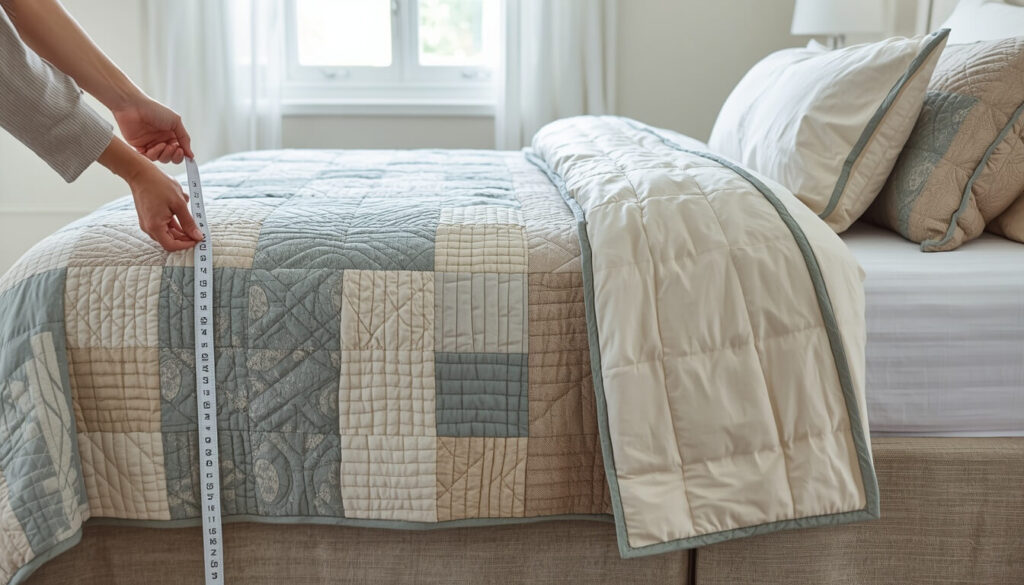
A bed quilt is based on the mattress size plus a “drop,” the amount the quilt hangs over the sides and foot. According to Amerisleep, the standard US mattress sizes are twin 38 × 75, twin XL 38 × 80, full 54 × 75, queen 60 × 80, king 76 × 80, and California king 72 × 84 inches.
This table works backward from the typical quilt sizes above, so you can see how much extra each one adds.
| Size | Mattress | Typical Quilt | Extra Width Per Side | Extra Length |
|---|---|---|---|---|
| Crib | 28 × 52 | 36 × 52 | 4 in | 0 in |
| Twin | 38 × 75 | 68 × 88 | 15 in | 13 in |
| Twin XL | 38 × 80 | 68 × 93 | 15 in | 13 in |
| Full | 54 × 75 | 80 × 90 | 13 in | 15 in |
| Queen | 60 × 80 | 90 × 108 | 15 in | 28 in |
| King | 76 × 80 | 108 × 108 | 16 in | 28 in |
| California king | 72 × 84 | 104 × 114 | 16 in | 30 in |
The larger extra length on queen, king, and California king includes a pillow tuck, the extra fabric that folds up over the pillows. Mattress sizes can vary by about an inch between makers, so measure your own bed.
How to Calculate a Custom Quilt Size
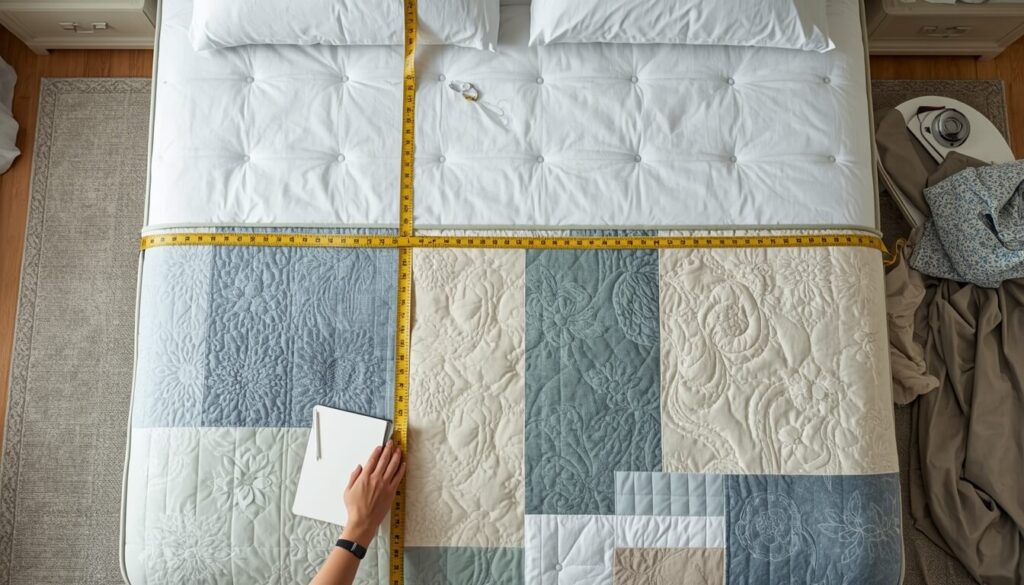
If your bed is deeper than average, or you want a different look, work out your own size. You only need your mattress measurements and two decisions.
Width = mattress width + (2 × side drop) Length = mattress length + foot drop + pillow tuck (optional)
Choose Your Drop
Measure the depth of your mattress first. The drop needs to cover it, and a bit more looks intentional.
| Look | Typical Drop |
|---|---|
| Snug, stops near the bed frame | 10 to 12 inches |
| Standard bed quilt | 13 to 16 inches |
| Full drape | 15 to 18 inches or more |
Standard innerspring mattresses are often 8 to 10 inches deep, which suits a 10 to 12 inch drop. Thicker pillow-top mattresses need more.
Add a Pillow Tuck
A pillow tuck lets the quilt fold up and over your pillows. Plan on about 10 to 13 extra inches of length if you want one, and skip it if the quilt will sit below the pillows.
Worked Example: A Queen Quilt
A queen mattress is 60 × 80 inches. Choose a 15 inch drop and a 13 inch pillow tuck.
- Width: 60 + (2 × 15) = 90 inches
- Length: 80 + 15 + 13 = 108 inches
- Finished size: 90 × 108 inches
Now a custom twin with a snugger drop. A twin mattress is 38 × 75. With a 12 inch drop and no pillow tuck, the width is 38 + 24 = 62 inches and the length is 75 + 12 = 87 inches. That’s a 62 × 87 quilt, smaller than the typical twin.
Why Every Quilt Size Chart Disagrees
You’ll find one chart showing a twin quilt at 60 × 80 and another at 70 × 90. They aren’t both wrong. Quilt sizes aren’t governed by one standard, so each chart makes different choices.
Here’s what changes the numbers:
- Drop. A short drop gives a smaller quilt, and a deep drop gives a bigger one.
- Pillow tuck. Some charts include it and some don’t. Quiltler’s quilt size chart finishes a queen at 90 × 95, while ours adds a pillow tuck to reach 90 × 108.
- Mattress depth. A thick mattress needs a longer drop.
- Purpose. A decorative quilt differs from one you sleep under.
- Pattern habits. Many patterns are designed around standard batting sizes, which is why 90 × 108 is so common for a queen.
When two charts disagree, pick the one that matches your mattress and your preferred look, then check it against the formula above.
Choosing a Quilt Size by Purpose
Not every quilt goes on a bed. Pick your size by how you’ll use it.
- Sofa lap quilt: 50 × 65 inches covers one person comfortably
- Large throw: 60 × 72 inches suits two people or generous coverage
- Nap blanket for an adult: 60 × 80 inches covers a full-length adult lying down
- Baby gift: 36 × 52 for a crib, or 36 × 48 for a stroller
- Dorm bed: use a twin XL quilt, about 68 × 93 inches
- Guest bed: a full or queen quilt is the safe choice
If you’re not sure, start with a smaller size. A lap or throw quilt is far easier to finish than a bed quilt, and it teaches every skill you’ll need. Our pillar guide on how to quilt with a sewing machine walks through the whole process.
What Your Quilt Size Means for Fabric
Once you’ve picked a size, the next step is buying fabric. The size sets the area you need for the top, the backing, and the binding.
- For the top, backing, and binding together, see our guide on how much fabric for a quilt.
- For the backing on its own, including seam direction and wide-back fabric, see how much backing fabric do I need for a quilt.
- For quick yardage figures by size, see the fabric yardage chart.
- For batting, see our quilt batting size chart.
You can also run your size through the Fabric Yardage Calculator for a rounded-up total.
Common Mistakes to Avoid
- Making the quilt the same size as the mattress, with no drop
- Forgetting the pillow tuck on a queen or king
- Using a twin quilt for a twin XL, which leaves the foot short
- Mixing up finished size and cut size
- Confusing king and California king, which are 4 inches different in width and length
- Ignoring mattress depth on a thick pillow-top bed
- Trusting a quilt size chart without checking it against your own mattress
FAQs
What are the standard quilt sizes?
Typical finished sizes are 36 × 52 inches for a crib, 50 × 65 for a lap, 60 × 72 for a large throw, 68 × 88 for a twin, 80 × 90 for a full, 90 × 108 for a queen, and 108 × 108 for a king. Treat any quilt size chart as a starting point.
What size is a queen quilt?
A typical queen quilt finishes at 90 × 108 inches for a 60 × 80 mattress. That gives about a 15 inch drop on each side, plus a 15 inch foot drop and a pillow tuck. Some charts finish it shorter, at 90 × 95, with no tuck.
What size is a throw quilt?
A lap or small throw is typically 50 × 65 inches, and a larger throw is about 60 × 72 inches. There’s no mattress to match, so choose the size by use. A nap blanket for an adult works well at about 60 × 80.
How much drop should a quilt have?
For a standard bed quilt, 13 to 16 inches on each side is common. A snug look uses 10 to 12 inches, and a full drape can go to 18 inches or more. Measure your mattress depth first, because the drop has to cover it.
What size quilt do I need for a twin XL?
A twin XL mattress is 38 × 80 inches, which is 5 inches longer than a standard twin. A typical twin XL quilt is about 68 × 93 inches. Use the formula with your own drop if you want a different look.
What’s the difference between a king and a California king quilt?
A king mattress is 76 × 80 inches and a California king is 72 × 84, so the California king is 4 inches narrower and 4 inches longer. A typical king quilt is 108 × 108, and a California king quilt is about 104 × 114.
How big should a baby quilt be?
A crib quilt is usually 36 × 52 inches, sized to a standard 28 × 52 inch crib mattress. A smaller baby or stroller quilt is about 36 × 48 inches. Baby quilts are flexible, since they’re often used for play more than for the crib.
How much bigger than the mattress should a quilt be?
A bed quilt usually adds 13 to 16 inches on each side, and extra length for the foot and a pillow tuck. That works out to about 30 inches wider and 13 to 30 inches longer than the mattress, depending on the size.
Conclusion
A reliable quilt size chart gives you a starting point, and the formula gives you the exact size for your bed. Measure your mattress, choose a drop, decide on a pillow tuck, and you have a finished size that fits.
Then turn that size into fabric with our guide on how much fabric for a quilt, or check your numbers with the Fabric Yardage Calculator.
Related articles