

How much fabric for a quilt depends on three separate calculations: the top, the backing, and the binding. Each one has its own rule and its own extra allowance, which is why a single “yards per quilt size” number rarely matches your project.
This guide gives you the formula for each part and then puts them together in a full worked example, so you end up with one shopping list. For the general method behind every fabric calculation, see our pillar guide on how much fabric do I need.
Table of Contents
Quick Answer
To work out how much fabric for a quilt, calculate three parts separately. For the top, multiply width by length, add 10 to 20 percent for waste, and divide by your usable fabric width times 36. For the backing, add 8 inches to each dimension and work out how many fabric panels you need. For the binding, divide the quilt’s perimeter plus about 12 inches by your fabric width to get the strips.
Add them together for your total, and always round up to the next quarter yard.
How Much Fabric for a Quilt: The Three Calculations
Here’s the whole method on one page. The sections below explain each row.
| Part | Formula | Allowance |
|---|---|---|
| Quilt top | (Width × Length × (1 + waste)) ÷ (usable width × 36) | 10 to 20% waste |
| Backing | Panels = round up ((Width + 8) ÷ usable width). Yards = panels × (Length + 8) ÷ 36 | 4 inches on each side |
| Binding | Strips = round up ((Perimeter + 12) ÷ usable width). Yards = strips × 2.5 ÷ 36 | About 12 inches for corners and the join |
| Batting | At least as large as the backing | See batting size guidance |
All of these use the usable width of your fabric, not the width on the bolt. Quilting cotton is typically 42 to 44 inches wide, but after you trim the selvedges, plan on about 40 inches. Our fabric width guide explains why.
Step 1: Calculate Fabric for the Quilt Top
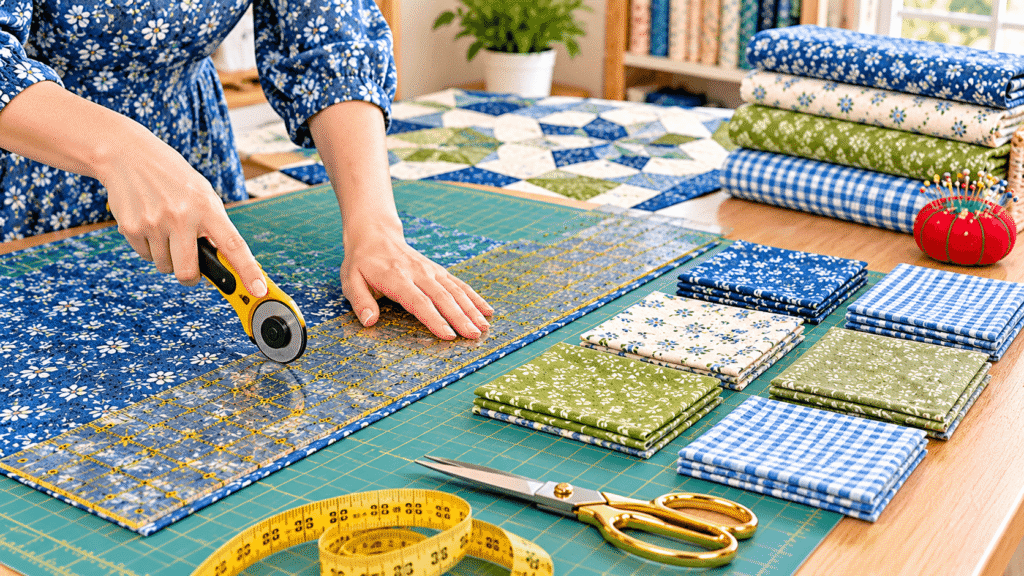
The top is the hardest part to calculate, because the answer depends on your design. A simple quilt of large squares uses fabric efficiently. A busy patchwork of small pieces wastes more in the cutting.
The Area Method (Quick Estimate)
This is the fastest way to estimate. It treats the top as one flat area of fabric, then adds waste.
Yards = (Width × Length × (1 + waste)) ÷ (usable width × 36)
Take a quilt top that finishes 50 by 65 inches, with 15 percent waste and 40 inches of usable width.
- Area: 50 × 65 = 3,250 square inches
- Add waste: 3,250 × 1.15 = 3,737.5 square inches
- Divide by one yard of usable fabric: 40 × 36 = 1,440 square inches
- Result: 3,737.5 ÷ 1,440 = 2.6 yards, so buy 2.75 yards
The same method works on any size. A 90 by 108 inch queen quilt top is 9,720 square inches. Add 15 percent for 11,178, divide by 1,440, and you get 7.8 yards, so buy 8 yards.
If your quilt uses several fabrics, split the total between them. Four fabrics in equal amounts means about a quarter of the total for each.
The Cutting Method (More Precise)
When you know your cut sizes, count how many pieces fit across one strip, then work out how many strips you need. This method accounts for the way fabric actually gets cut.
Suppose you’re cutting 12.5 inch squares, which finish at 12 inches, and you need 20 of them from one fabric.
- Pieces per strip: 40 ÷ 12.5 = 3.2, so 3 squares fit across
- Strips needed: 20 ÷ 3 = 6.7, so 7 strips
- Length: 7 strips × 12.5 inches = 87.5 inches
- Yardage: 87.5 ÷ 36 = 2.4 yards, so buy 2.5 yards
Always round the pieces per strip down and the strips up. Add a few inches of safety if you’re nervous about your cutting.
Choose Your Waste Factor
Waste covers cutting errors, grain alignment, and mismatched cuts. These common guidelines help you pick a number.
| Quilt Type | Waste Factor |
|---|---|
| Simple solids or large pieces | About 10% |
| Standard patchwork | About 15% |
| Complex, directional, or fussy-cut prints | About 20% |
If you’re not sure, start with 15 percent. You can always have leftover fabric for the next project, but you can’t add fabric back after you’ve cut.
For help measuring accurately before you cut, see our fabric measurement guide.
Step 2: Calculate Backing Fabric

The backing has to be bigger than the top. Most quilters add about 4 inches on every side, which means 8 inches added to both the width and the length. That extra room gives you space for the layers to shift slightly during quilting.
Then work out how many panels of fabric you need. If your backing is wider than your usable fabric width, you’ll need to seam two or more panels together.
Panels = round up ((Width + 8) ÷ usable width) Yards = panels × (Length + 8) ÷ 36
Here’s a quick example for the 50 by 65 inch quilt. The backing needs to be 58 by 73 inches. At 40 inches of usable width, that’s 2 panels. Two panels of 73 inches is 146 inches, or about 4.1 yards, so buy 4.25 yards.
That’s the simple layout. A smarter layout can bring the number down noticeably, and extra-wide backing fabric cuts it further. Our quilt backing fabric guide covers both in detail.
Step 3: Calculate Binding Fabric
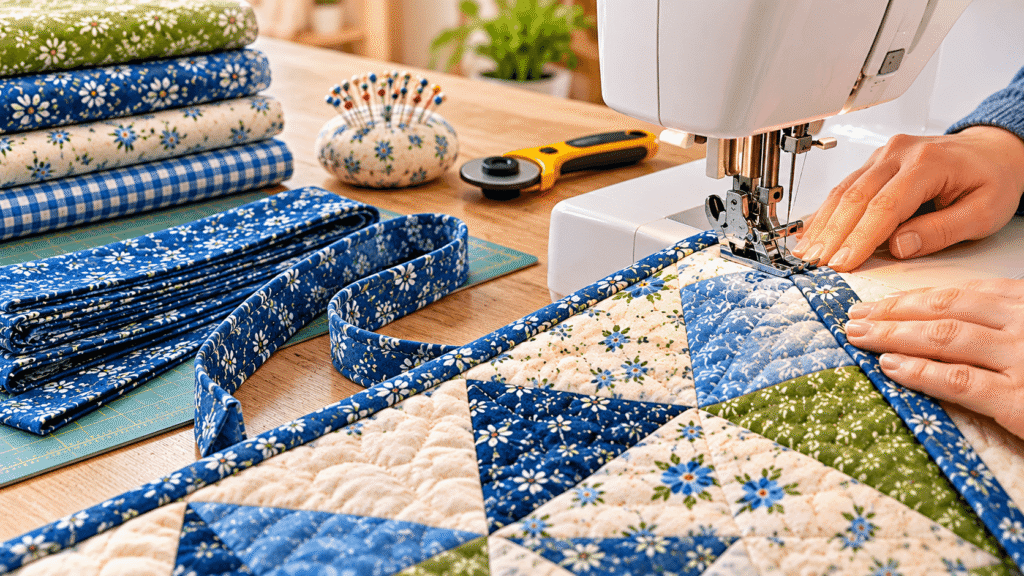
Binding is a long, narrow strip, so you calculate it from the quilt’s perimeter, not its area. Add up all four sides, then add about 12 inches for the corners and the join.
Strips = round up ((Perimeter + 12) ÷ usable width) Yards = strips × 2.5 ÷ 36
For a 50 by 65 inch quilt, the perimeter is 230 inches. Add 12 for 242, then divide by 40 and you get 6.05, which rounds up to 7 strips. Seven strips at 2.5 inches is 17.5 inches, so a half yard covers it.
If your result lands right at a whole number, round up one extra strip. Running short on binding is frustrating, and an extra strip costs almost nothing.
Strip width can vary with your method, so check it against your plan. For the sewing itself, see our guide on how to bind a quilt with a sewing machine.
What About Batting?
Batting isn’t sold by the yard in the same way, so you buy it by size. A good rule is to buy batting at least as large as your backing.
Our quilt batting size guide lists the standard sizes. For quilt sizes from baby to king, see our quilt size chart.
Worked Example: How Much Fabric for a Quilt That Measures 50 x 65 Inches
Here’s everything together for a throw quilt, using a usable width of 40 inches and a 15 percent waste factor.
| Part | Calculation | Buy |
|---|---|---|
| Quilt top | (50 × 65 × 1.15) ÷ 1,440 = 2.6 yards | 2.75 yards |
| Backing | 2 panels × 73 inches = 146 inches ÷ 36 = 4.1 yards | 4.25 yards |
| Binding | (230 + 12) ÷ 40 = 7 strips × 2.5 inches ÷ 36 = 0.49 yards | 0.5 yard |
| Batting | At least 58 × 73 inches | One batting at least that size |
That’s about 7.5 yards of fabric in total, plus batting.
You’ll notice this is a little higher than the quick estimates in our fabric yardage chart. The chart gives fast starting figures that assume efficient layouts. A formula built on your exact size and fabric width gives you the number to actually buy.
Adjusting for Shrinkage, Borders, Sashing, and Directional Prints
Four things change the basic numbers of how much fabric for a quilt you need.
Shrinkage. If you prewash your top fabrics, prewash the backing too, and add about 10 percent extra to cover shrinkage.
Borders. Calculate borders as their own strips. Add the lengths of all four sides, add a few inches for joins, divide by usable width, and multiply the strip count by the cut width. For example, 6 border strips cut at 4.5 inches come to 27 inches, or about three quarters of a yard.
Sashing. Work it out the same way. Add the lengths of all sashing strips, divide by usable width, and multiply by the strip width. Add 5 to 10 percent for joining.
Directional prints. A print with an up and down, or a large repeat, wastes more fabric because every piece has to face the same way. Use the 20 percent waste factor, and read our pillar guide on how much fabric do I need for pattern repeats.
Use the Fabric Yardage Calculator
You can run all of these formulas by hand to find how much fabric for a quilt you need, or let the tool do it. The SewSmartHub Fabric Yardage Calculator takes your measurements and fabric width, and gives you a rounded-up yardage you can take straight to the shop.
It’s a quick way to check your arithmetic before you cut.
Quick Checklist Before You Buy
Run through this list before you head to the shop.
- Measure the finished quilt top, and write down the width and length
- Trim the selvedge in your head, and use about 40 inches of usable width
- Pick a waste factor that matches your design
- Calculate the top, the backing, and the binding separately
- Add up the three yardages, and round each up to the next quarter yard
- Check your batting size against your backing size
- Run the numbers through the calculator as a second opinion
Helpful Tips for Buying Quilt Fabric
- Buy all the fabric for one quilt at the same time, since different batches of the same print can vary slightly.
- Buy the backing and binding fabric with the top fabric, so nothing runs out before you finish.
- If your design uses small pieces from many prints, fat quarters can be handy. Our fabric measurement guide explains how a fat quarter differs from a quarter yard.
- Keep your cutting notes, so you can reorder the same amount if you make the quilt again.
Common Mistakes to Avoid
These are the usual reasons people misjudge how much fabric for a quilt they need.
- Using the bolt width instead of the usable width after trimming selvedges
- Forgetting the extra 4 inches on each side of the backing
- Treating the binding like a rectangle instead of a perimeter
- Skipping the waste factor on the top
- Rounding strips down instead of up
- Not prewashing the backing when the top fabrics were prewashed
- Buying exactly the calculated amount with no safety margin
FAQs
How much fabric do I need for a throw quilt?
For a 50 by 65 inch throw with a 15 percent waste factor, expect about 2.75 yards for the top, 4.25 yards for a simple pieced backing, and half a yard for binding. That’s around 7.5 yards in total, plus batting. A smarter backing layout reduces it.
How much extra fabric should I buy for a quilt?
Add 10 to 20 percent to the top for waste, depending on your design. For the backing, add about 4 inches on every side. For the binding, add about 12 inches to the perimeter for corners and the join, and round up to a whole strip.
How much backing fabric do I need for a quilt?
Add 8 inches to the quilt’s width and length, then work out how many panels fit across your usable fabric width. Multiply the panels by the backing length and divide by 36. Extra-wide backing fabric can reduce this a lot.
How much fabric do I need for quilt binding?
Add up all four sides, add about 12 inches, and divide by your usable fabric width to get the number of strips. Multiply the strips by 2.5 inches, then divide by 36. A throw quilt usually needs about half a yard.
Should I prewash fabric and add extra for shrinkage?
If you prewash your top fabrics, prewash the backing too and add about 10 percent extra fabric to cover shrinkage. If you don’t prewash anything, shrinkage is less of a concern, but you’ll want to keep your quilt’s care instructions in mind.
How do I calculate fabric for a patchwork quilt?
Use the cutting method. Work out how many pieces fit across one strip of usable fabric width, divide the number of pieces you need by that, and round up to get the strips. Multiply the strips by the cut height, and divide by 36 for yards.
What usable width should I use for quilting cotton?
Quilting cotton is typically 42 to 44 inches on the bolt, but the selvedges come off. Planning on about 40 inches of usable width is a safe choice. If you’d like more precision, measure your actual fabric after trimming, and use that number in every formula.
Does a directional print need more fabric?
Yes. A print with an obvious direction or a large pattern repeat wastes more fabric, because every piece has to face the same way and line up. Use a waste factor around 20 percent, and consider buying a little more for matching.
Conclusion
Once you know how much fabric for a quilt each part needs, buying fabric stops being a guess. Work out the top, the backing, and the binding separately, add the right allowance to each, and round up.
Then check your arithmetic with the Fabric Yardage Calculator before you head to the shop. For the full quilting process after you buy, see our pillar guide on how to quilt with a sewing machine.
Related articles