

How much fabric for pillows comes down to a small, repeatable calculation: add a seam allowance to your finished size, double it for a front and back piece, then see how many of those fit across your fabric’s width. Pillow covers are one of the most forgiving projects to calculate yardage for, since the pieces are simple squares or rectangles rather than curved garment shapes. This guide covers the numbers by common pillow size, the formula behind them, and the details piping, envelope backs, multiple pillows that shift your total.
Table of Contents
Quick Answer
For a single pillow cover, add a 1-inch seam allowance to each side of your finished pillow size, cut one front and one back piece at that size, and see how many fit across your fabric’s width. Most standard 14 to 18-inch pillows need about half a yard of 45-inch fabric each, while larger 20 to 24-inch pillows typically need closer to three-quarters of a yard.
How Much Fabric for Pillows by Size: Quick-Reference Table
These figures are for a single, simple two-piece pillow cover with a 1-inch seam allowance, before accounting for piping or an envelope back overlap.
| Pillow Size | 45″ Fabric | 54–58″ Fabric |
|---|---|---|
| 12 x 12 in | 0.4 yards | 0.3 yards |
| 14 x 14 in | 0.5 yards | 0.4 yards |
| 16 x 16 in | 0.5 yards | 0.4 yards |
| 18 x 18 in | 0.6 yards | 0.5 yards |
| 20 x 20 in | 0.7 yards | 0.6 yards |
| 22 x 22 in | 1 yard | 0.7 yards |
| 24 x 24 in | 1 yard | 0.8 yards |
The Pillow Fabric Formula
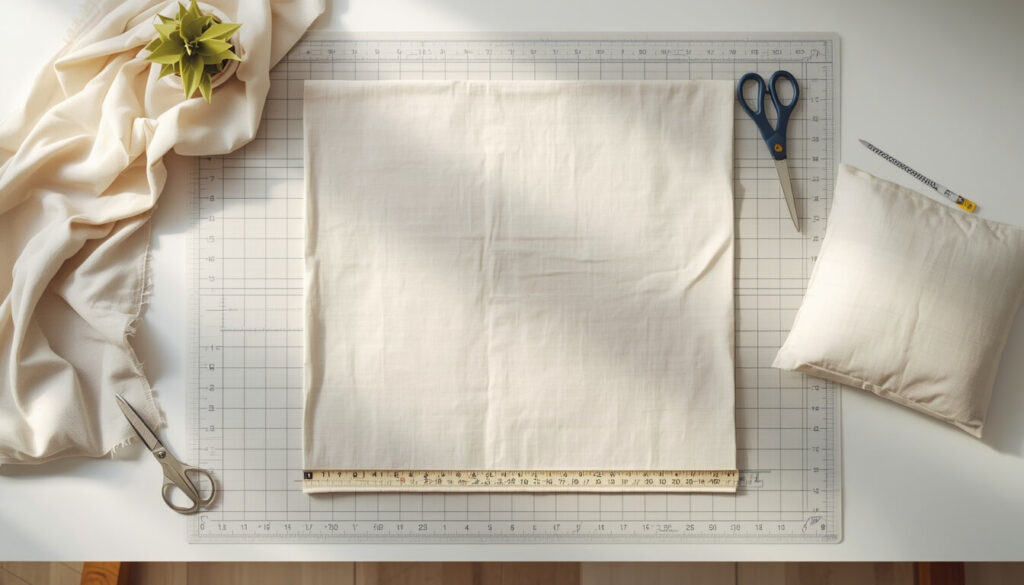
Step 1 — Add Seam Allowance to Your Finished Size
Add your seam allowance to each side of the finished pillow dimensions. A ½-inch seam allowance on an 18-inch pillow gives you a 19 by 19 inch cut piece, since the allowance is added twice — once on each side.
Finished size + (2 × seam allowance) = cut piece size
Step 2 — Fit Front and Back Pieces Across Your Fabric Width
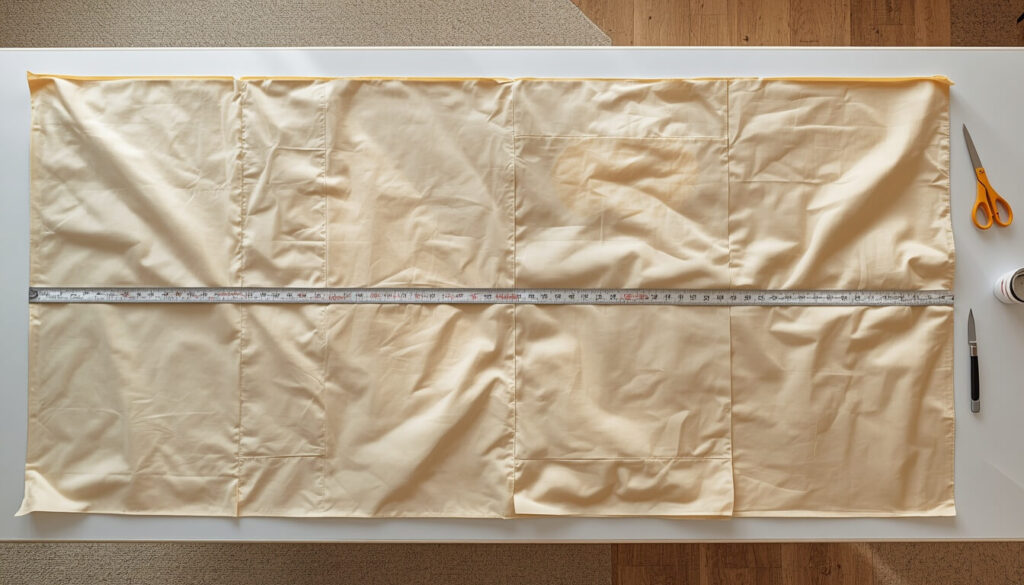
Divide your fabric’s usable width by your cut piece size, and round down to see how many pieces fit in a single row. A pillow cover needs two pieces total — one front, one back — so a 45-inch fabric width comfortably fits both side by side for most standard pillow sizes.
Step 3 — Convert to Yards
Once you know how many rows you need, multiply by your cut piece length and divide by 36 to get yards, rounding up to the nearest quarter or eighth yard your fabric store sells in.
Envelope Back vs. Zipper Back Does Closure Style Change Yardage?
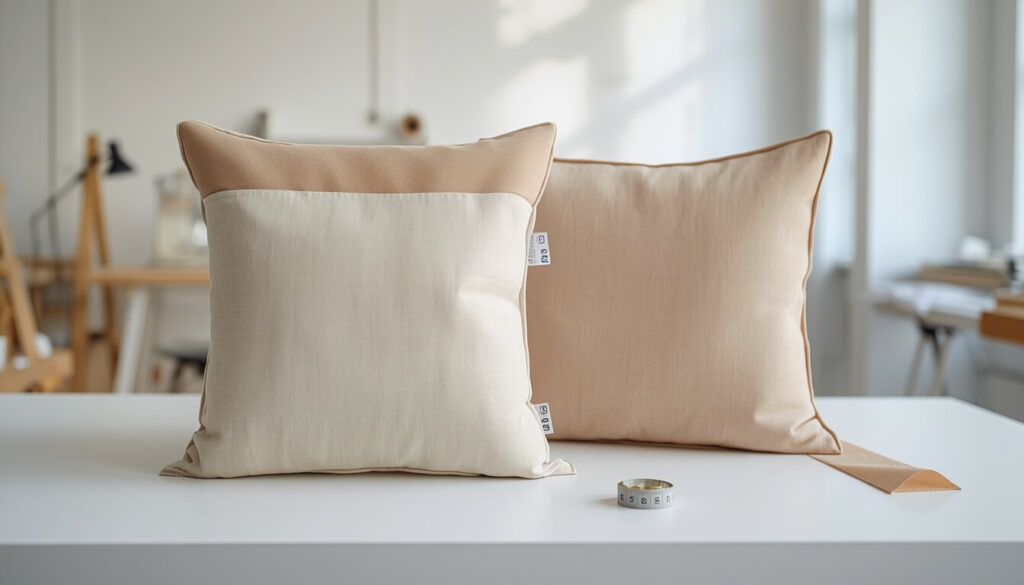
Yes, and it’s an easy detail to miss. A zipper back uses one back piece the same size as your front. An envelope back instead splits the back into two overlapping panels, each needing extra width for that overlap — typically 4 to 6 inches of extra fabric split between the two panels compared to a single zipper-back piece. Budget slightly more fabric for an envelope back than the table above assumes, especially on smaller pillows where that overlap takes up a larger share of the total.
Making Multiple Pillows at Once
Buying fabric for several matching pillows at once is usually more efficient than calculating each one separately, since front and back pieces from different pillows can often share the same row across your fabric’s width. For four 18-inch pillows on 45-inch fabric, you’ll typically need somewhat less than four times the single-pillow yardage, since the pieces nest together with less leftover fabric per pillow than when cutting just one at a time.
Don’t Forget Piping or Trim
According to Wikipedia, piping is a strip of folded fabric, usually cut on the bias, inserted into a seam to define the edge of a pillow, cushion, or other textile project. If you’re planning piped edges, that strip is cut separately from your front and back panels and needs its own yardage, calculated from the pillow’s total perimeter rather than the flat fabric formula above.
Measure around all four sides of your finished pillow size, add a few extra inches for joining the ends, and convert that length to yards separately from your main fabric total.
Common Mistakes to Avoid
- Forgetting to add seam allowance twice — once on each side — when calculating cut piece size
- Assuming an envelope back needs the same yardage as a zipper back, without accounting for the overlap
- Calculating piping yardage from the same formula as flat panels instead of from the pillow’s perimeter
- Not accounting for a directional print or pattern repeat on multiple pillows
- Buying the bare minimum with no allowance for a cutting mistake
FAQs
How much fabric do I need for one 18×18 pillow?
On 45-inch fabric, a simple two-piece 18×18 pillow cover typically needs about 0.6 yards, assuming a 1-inch seam allowance and a zipper back. An envelope back needs slightly more to cover the overlapping panels.
Does an envelope pillow back need more fabric than a zipper back?
Yes. An envelope back splits the back piece into two overlapping panels, which together need 4 to 6 inches more fabric than a single zipper-back piece of the same pillow size.
How much fabric do I need for four matching pillows?
Buying for several pillows at once is usually more efficient than multiplying a single pillow’s yardage by the quantity, since front and back pieces from different pillows can often share the same row across the fabric width. Expect somewhat less than four times the single-pillow figure for four pillows.
How much extra fabric do I need for piping?
Piping yardage is calculated separately from your front and back panels, based on the pillow’s total perimeter plus a few extra inches for joining the ends. It isn’t part of the flat panel calculation used for the pillow front and back.
Does fabric width change how much I need for pillows?
Yes, though the effect is smaller than on larger projects like curtains, since pillow pieces are small enough that most standard widths fit two pieces per row either way. Wider fabric mainly helps when cutting multiple pillows at once.
Conclusion
Once you know how much fabric for pillows your project needs, size by size, pillow covers become one of the quickest projects to shop for accurately. The details that trip people up an envelope back’s overlap, piping cut from the perimeter rather than the flat panel formula, and fabric efficiency across multiple pillows are exactly the parts a flat “half a yard per pillow” rule of thumb misses.
For the full general formula this builds on, see our pillar guide on how much fabric do I need, or skip the math with the SewSmartHub fabric yardage calculator.