

How much fabric for curtains comes down to a formula most people never see written out in full: pole width times fullness, divided by fabric width, times cut drop. Curtains use noticeably more fabric than their finished width suggests, because a flat, gathered heading needs two to three times the pole width just to create proper folds. This guide walks through that formula step by step, including how pattern repeats change the total, with a worked example at the end.
Table of Contents
Quick Answer
To calculate how much fabric for curtains you need, multiply your pole or track width by your chosen fullness to get the total flat width, then divide by your fabric’s usable width and round up to a whole number of fabric widths. Multiply that by your finished drop plus a heading and hem allowance, adjusting for any pattern repeat, and convert the total to yards. Most standard windows need 4 to 8 yards per panel, depending on drop length and fullness.
Measure the Pole or Track, Not the Window
A common mistake is measuring the window opening itself, but curtains hang from the pole or track, which usually extends well beyond the window frame on both sides. Measure the installed pole or track width, not including decorative finials, since that’s the actual span your fabric needs to cover once gathered.
Choose Your Curtain Fullness
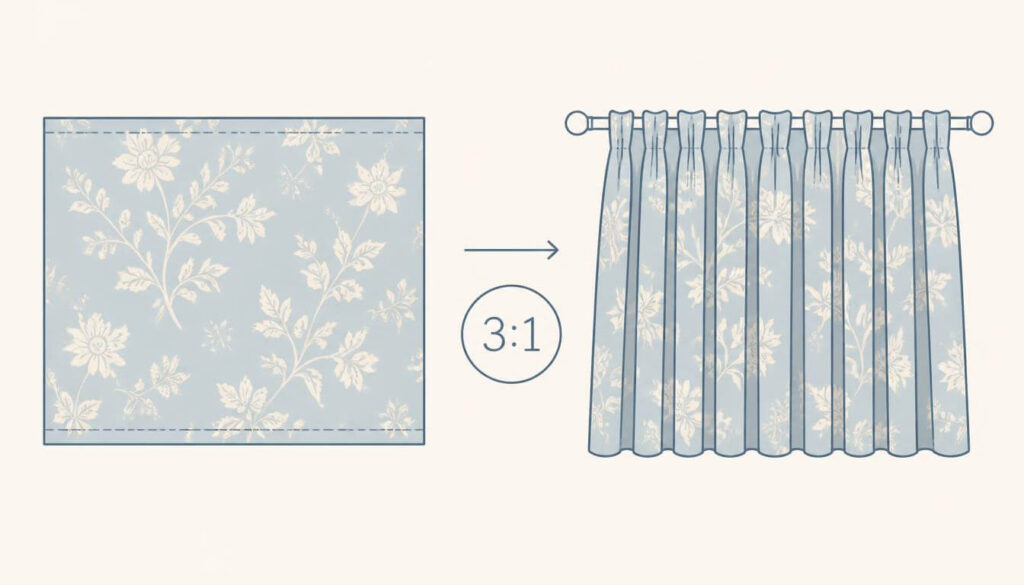
Fullness is the ratio between your flat fabric width and the finished, gathered curtain width — it’s what creates the folds instead of a flat panel of fabric. According to Wikipedia, pleats are commonly formed at roughly a 3:1 ratio, where three inches of flat fabric produce about one inch of finished pleat, which is part of why gathered curtain headings need so much extra width.
| Heading Style | Typical Fullness |
|---|---|
| Pencil Pleat | 2 to 2.5 times pole width |
| Eyelet | 2 times pole width |
| Pinch Pleat (Double/Triple) | 2 to 2.5 times pole width |
| Wave | Set by the track system manufacturer |
How Much Fabric for Curtains: Step-by-Step Formula
Step 1 — Total Flat Width
Multiply your pole or track width by your chosen fullness ratio.
Pole width × fullness = total flat width
Step 2 — Number of Fabric Widths
Divide your total flat width by your fabric’s usable width, and always round up to a full width — a result of 3.2 means you need four widths, not three and a fraction.
Total flat width ÷ usable fabric width = number of widths
Step 3 — Raw Cut Drop
The cut drop is the length of fabric needed per width, before any pattern adjustment. Add a heading and hem allowance to your finished drop measurement.
Finished drop + heading and hem allowance = raw cut drop
Step 4 — Adjust for Pattern Repeat
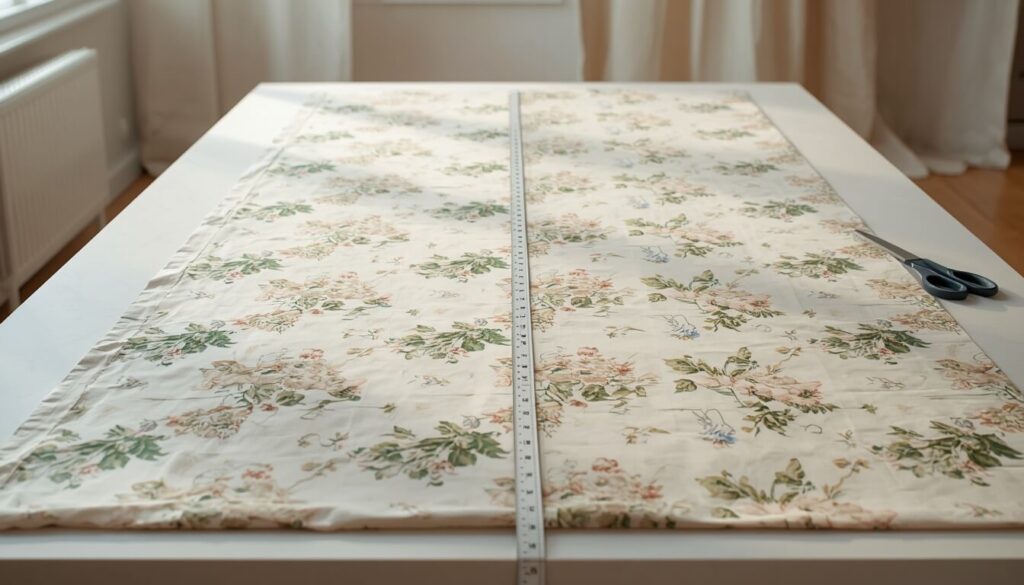
If your fabric has a repeating print, round the raw cut drop up to the next full pattern repeat, so the design lines up across joined widths.
Matched cut drop = round up (raw cut drop ÷ vertical repeat) × vertical repeat
For plain fabric, skip this step and use your raw cut drop as-is.
Step 5 — Total Yardage
Multiply your number of widths by your matched (or raw) cut drop, then convert to yards by dividing by 36.
Number of widths × cut drop ÷ 36 = total yards
Worked Example
Assume the following measurements:
- Pole width: 100 inches
- Fullness: 2 times
- Usable fabric width: 54 inches
- Finished drop: 84 inches
- Heading and hem allowance: 8 inches
- Vertical pattern repeat: 25 inches
- Total flat width: 100 × 2 = 200 inches
- Number of widths: 200 ÷ 54 = 3.7, rounded up to 4 widths
- Raw cut drop: 84 + 8 = 92 inches
- Matched cut drop: 92 ÷ 25 = 3.68, rounded up to 4 repeats. 4 × 25 = 100 inches
- Total yardage: 4 widths × 100 inches = 400 inches ÷ 36 = 11.1 yards, rounded up to 11.25 yards
Without the pattern repeat adjustment, the same window would only need 4 × 92 inches ÷ 36, or about 10.2 yards — a reminder of how much a repeat can add to the final total.
Should Curtain Lining Be Calculated Separately?
Yes. Lining fabric is almost always calculated on its own, since it may come in a different usable width and typically doesn’t need pattern matching the way your face fabric does. Run the same formula above using your lining fabric’s width in place of your main fabric’s width, skipping the pattern repeat step entirely for a plain lining.
Common Mistakes to Avoid
- Measuring the window opening instead of the installed pole or track width
- Forgetting to include fullness, which results in flat, un-gathered curtains
- Using the fabric’s nominal width instead of its usable width after trimming the selvedge
- Rounding the number of fabric widths down instead of up
- Skipping the pattern repeat adjustment on a printed fabric
- Assuming lining needs the same yardage as your main fabric without recalculating
FAQs
How much fabric do I need for pencil pleat curtains?
Pencil pleat headings typically use 2 to 2.5 times your pole or track width in fullness, which is on the higher end compared to some other heading styles. Run this fullness ratio through the step-by-step formula above using your specific pole width and drop.
Do I multiply curtain width by two?
Many heading styles use roughly double fullness, but not all of them wave headings, for example, follow the specific track system’s own fullness recommendation rather than a fixed multiplier. Always check the heading tape or track instructions before assuming a fixed ratio.
How much extra fabric do I need for a pattern repeat?
It depends on the size of the vertical repeat and how many fabric widths you need, since each cut drop gets rounded up to a full repeat. A large repeat across several widths can add a yard or more compared to the same window in a plain fabric.
Is curtain lining calculated the same way as the main fabric?
The formula is the same, but the inputs usually differ lining often comes in a different usable width and doesn’t need a pattern repeat adjustment. Run the formula separately using your lining fabric’s specific width.
Should I round up my final curtain fabric total?
Yes, always round up both the number of fabric widths and the final yardage to the next full increment your fabric is sold in. It’s far easier to have a small surplus than to come up short partway through cutting.
Conclusion
Once you’ve run through this formula pole width, fullness, number of widths, cut drop, and pattern repeat buying curtain fabric stops being a guess and becomes a calculation you can trust. The same window can need noticeably different yardage depending on heading style and whether the fabric has a repeat, which is exactly why a flat “yards per window” estimate rarely holds up in practice.
For a general refresher on the base yardage formula this builds on, see our pillar guide on how much fabric do I need, or skip the math with the SewSmartHub fabric yardage calculator.