
A fabric conversion chart solves one specific problem: your pattern lists yardage for a fabric width you don’t actually have. Patterns are almost always written against 44 to 45-inch fabric, but plenty of fabric on the shelf runs narrower or considerably wider than that. This guide covers the formula behind fabric width conversion, a ready-made chart for the most common widths, and how to handle yards versus meters if you’re working from an international pattern.
Table of Contents
Quick Answer
To convert fabric yardage between widths, multiply your pattern’s listed yardage by the original width and divide by your new fabric’s width. Going from 45-inch to 60-inch fabric roughly multiplies your yardage by 0.75, while going from 45-inch down to 36-inch multiplies it by about 1.25. The chart below covers the most common width combinations without you needing to run the math yourself.
The Fabric Width Conversion Formula
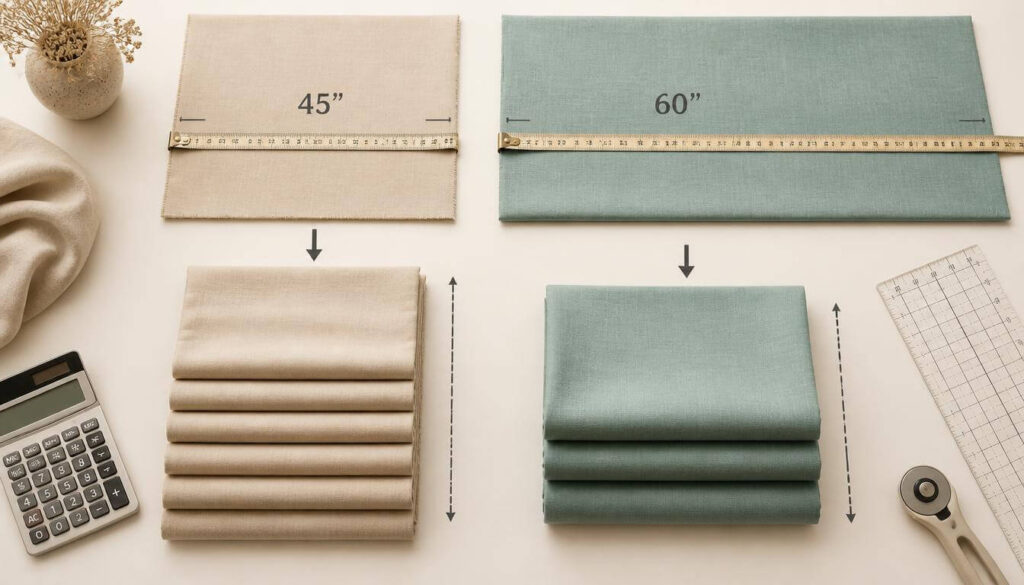
This conversion works on the idea that the total area of fabric needed stays roughly the same, even as the shape of that area changes with a different width.
New yardage = Old yardage × (Old width ÷ New width)
Wider fabric needs less yardage, and narrower fabric needs more, since the same total area has to stretch across a different width.
Fabric Conversion Chart (44/45″ Baseline)
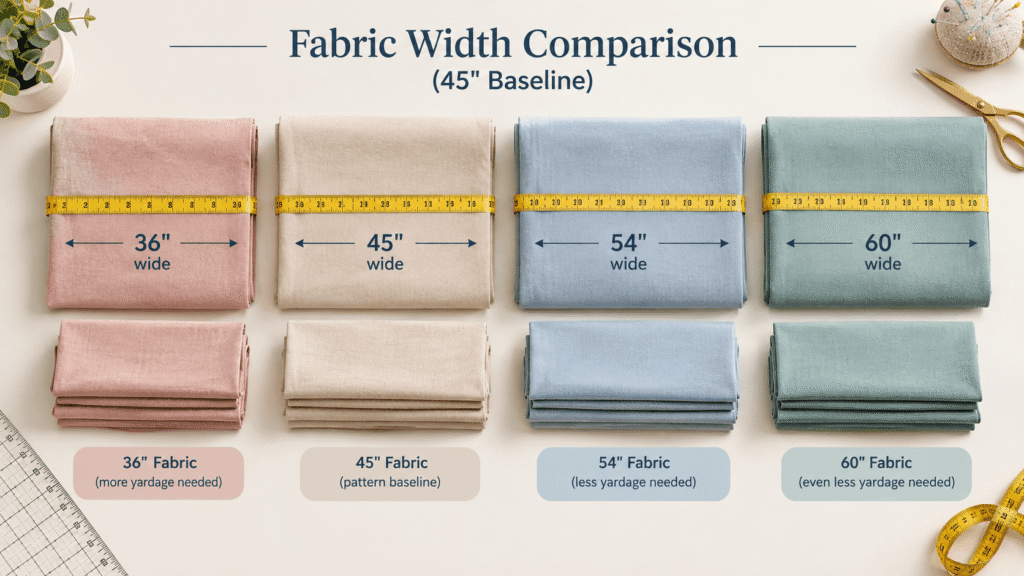
These figures assume your pattern’s yardage was calculated for 44 to 45-inch fabric, converted to three other common widths and rounded to the nearest eighth yard.
| 45″ Fabric | 36″ Fabric | 54″ Fabric | 60″ Fabric |
|---|---|---|---|
| 1 yard | 1 1/4 yards | 7/8 yard | 3/4 yard |
| 1.5 yards | 1 7/8 yards | 1 1/4 yards | 1 1/8 yards |
| 2 yards | 2 1/2 yards | 1 5/8 yards | 1 1/2 yards |
| 2.5 yards | 3 1/8 yards | 2 1/8 yards | 1 7/8 yards |
| 3 yards | 3 3/4 yards | 2 1/2 yards | 2 1/4 yards |
| 3.5 yards | 4 3/8 yards | 2 7/8 yards | 2 5/8 yards |
| 4 yards | 5 yards | 3 3/8 yards | 3 yards |
If your exact yardage falls between two rows, round up to the next row rather than down, or run the formula above directly for a precise figure.
Worked Example
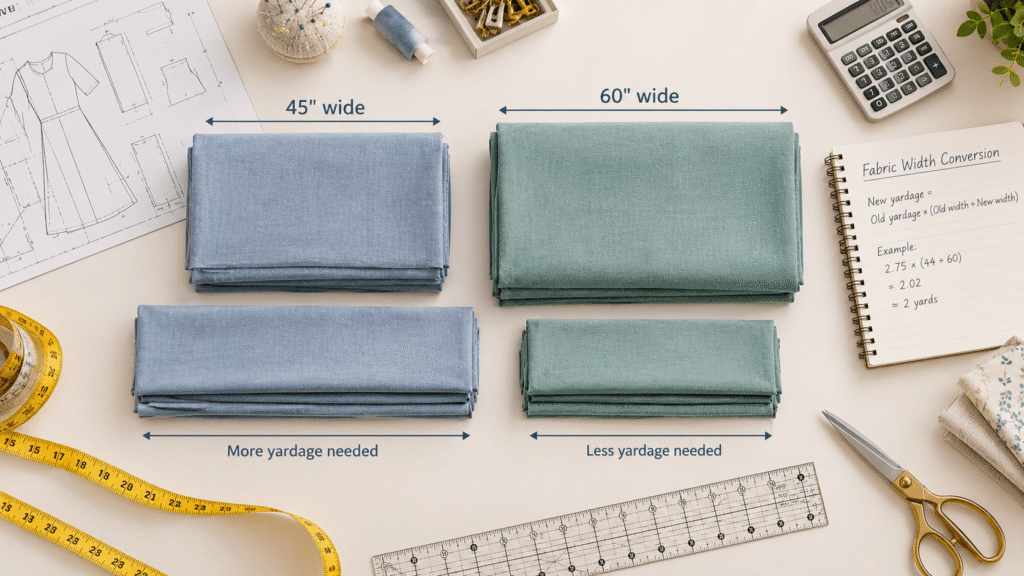
Say your pattern calls for 2.75 yards of 44-inch fabric, but the fabric you’ve chosen is 60 inches wide.
- Set up the formula: 2.75 × (44 ÷ 60)
- Divide the widths: 44 ÷ 60 = 0.733
- Multiply by the original yardage: 2.75 × 0.733 = 2.02
- Round up: 2 yards, or 2.125 yards to be safe
You’d need roughly 2 yards of the 60-inch fabric to replace 2.75 yards of the original 44-inch fabric the pattern called for.
Converting Yards to Meters (and Back)
International patterns, especially those from European pattern companies, list yardage in meters rather than yards. According to Wikipedia, one yard has been standardized as exactly 0.9144 meters since 1959, which makes a meter roughly 9% longer than a yard.
To convert meters to yards, multiply by 1.094. To convert yards to meters, multiply by 0.914. A pattern calling for 2 meters needs about 2.19 yards — round up to 2.25 yards to be safe rather than buying the bare minimum.
When This Conversion Isn’t Exact
This formula assumes your pattern pieces can be laid out efficiently at any width, which holds true for most simple garments and home decor projects but isn’t guaranteed for every layout. A pattern with large pieces that only fit one particular way, a directional print, or a design with extensive pattern matching may need more fabric than the straight conversion suggests, regardless of width. When in doubt, round up and buy a bit more than the chart indicates.
Common Mistakes to Avoid
- Rounding down instead of up when the converted figure falls between two chart values
- Assuming the conversion is exact for patterns with large or oddly shaped pieces
- Mixing up which width is the “original” and which is the “new” width in the formula
- Forgetting to convert meters to yards before comparing to a US-based yardage chart
- Not accounting for a directional print or pattern repeat on top of the basic width conversion
FAQs
How do I convert fabric yardage from 45 inch to 60 inch?
Multiply your 45-inch yardage by 45, then divide by 60 — this comes out to roughly three-quarters of your original yardage. For example, 2 yards of 45-inch fabric converts to about 1.5 yards of 60-inch fabric.
How much fabric do I need if my pattern calls for a width I can’t find?
Use the fabric width conversion formula, multiplying your pattern’s yardage by the original width and dividing by your actual fabric’s width, then round up to the nearest quarter or eighth yard.
Is a meter longer than a yard?
Yes, a meter is about 9% longer than a yard, since one yard equals exactly 0.9144 meters. If a pattern lists yardage in meters, multiply by 1.094 to convert to yards, then round up.
Does this conversion work for every type of pattern?
It works well for most garments and simple home decor projects, but patterns with large pieces, directional prints, or extensive pattern matching may need more fabric than a straight width conversion suggests. Round up when in doubt.
What’s the fastest way to convert fabric width without doing the math?
The chart above covers the most common width combinations at a glance. For a width or yardage not listed, the formula original yardage times original width, divided by new width gives an exact figure in seconds.
Conclusion
Once you know the formula behind a fabric conversion chart, a pattern written for the “wrong” width stops being a problem and becomes a quick calculation. The chart above covers the most common combinations, and the formula handles anything it doesn’t.
For the full general yardage formula this builds on, see our pillar guide on how much fabric do I need, or skip the math with the SewSmartHub fabric yardage calculator.