
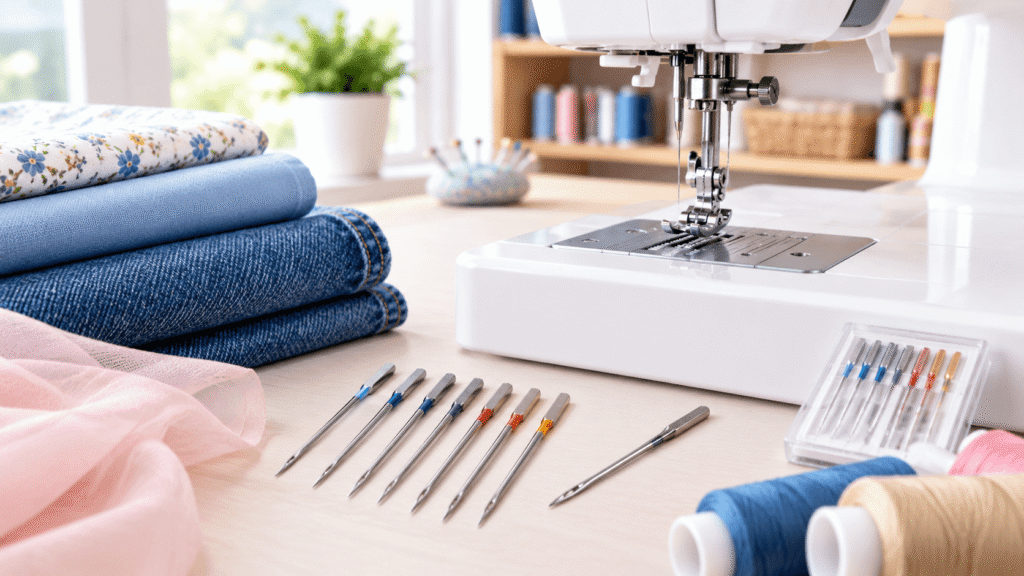
What size sewing machine needle you need comes down to two things: how heavy your fabric is and how thick your thread is. A needle that’s too fine bends, snaps, or skips stitches. A needle that’s too coarse leaves visible holes in delicate cloth.
This guide gives you a clear size chart first, then the exact sizes for cotton, denim, jeans, and quilting. You’ll also find a thread-pairing table that most needle guides skip.
Not sure where to start? An 80/12 universal needle handles most everyday sewing, and everything below helps you decide when to move up or down from there.
Table of Contents
Quick Answer
If you’re unsure, start with an 80/12 universal needle. It sews most medium-weight woven fabrics, including quilting cotton and shirting.
Go finer for delicate fabric: 60/8 to 70/10 for chiffon, silk, and cotton lawn. Go heavier for tougher fabric: 90/14 for linen and twill, 100/16 for denim and jeans, and 110/18 for heavy canvas and thick seams.
What Size Sewing Machine Needle: Quick-Reference Chart
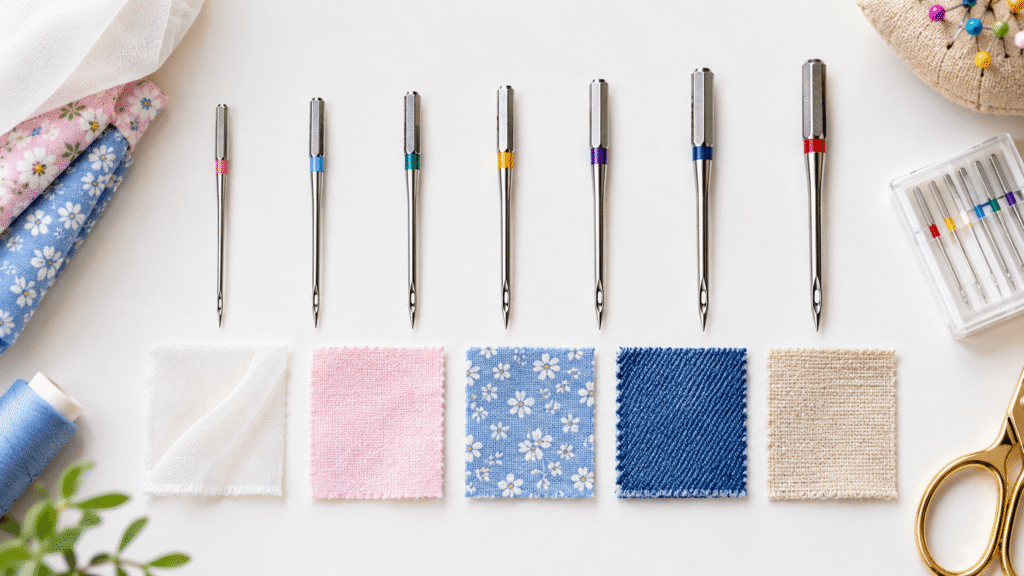
Bookmark this chart. It covers the sizes you’ll reach for on almost every project.
The first number in each size is the European (metric) size. According to Wikipedia, that number is the needle’s diameter in hundredths of a millimeter, so an 80 needle is 0.80 mm thick.
| Size (EU/US) | Diameter | Fabric Weight | Common Fabrics | Typical Needle Type |
|---|---|---|---|---|
| 60/8 | 0.60 mm | Very fine | Chiffon, organza, fine silk, lace | Universal or Microtex |
| 70/10 | 0.70 mm | Lightweight | Cotton lawn, voile, lining | Universal or Microtex |
| 75/11 | 0.75 mm | Light | Light cotton, rayon, light knits | Universal, Jersey, or Stretch |
| 80/12 | 0.80 mm | Medium | Quilting cotton, shirting, poplin | Universal or Quilting |
| 90/14 | 0.90 mm | Medium to heavy | Linen, twill, corduroy, fleece, light denim | Universal, Jeans, or Ballpoint |
| 100/16 | 1.00 mm | Heavy | Denim, canvas, heavy upholstery fabric | Jeans/Denim |
| 110/18 | 1.10 mm | Very heavy | Heavy denim, thick canvas, faux fur | Jeans or Leather |
A simple way to think about it: the heavier and denser the fabric, the thicker the needle shaft has to be to push through without bending.
What Size Sewing Machine Needle for Cotton?
Cotton covers a huge range, from see-through voile to stiff canvas. That’s why “cotton” alone doesn’t give you a single size.
Lightweight Cotton (Lawn, Voile)
Use a 70/10 needle, or a 75/11 if the fabric is slightly crisper. These fine needles slide between the threads without leaving big holes.
Picture a cotton voile blouse hemmed with a 90/14 needle. The seam looks fine at first, but you’ll often see small puckers and a row of visible needle holes along the hem. Swapping to a 70/10 gives a cleaner, flatter line.
Quilting Cotton and Cotton Shirting
Use an 80/12 universal needle. It’s the all-rounder for medium-weight cotton, and it’s what most sewists keep in the machine by default.
For piecing a quilt top with standard 50-weight cotton thread, an 80/12 works well, and a 75/11 quilting needle is a good alternative. Move up to 90/14 for heavier cotton like twill or cotton duck.
What Size Sewing Machine Needle for Denim and Jeans?

Denim is where needle size matters most. Tight weave, thick threads, and stacked seams all fight your needle on every stitch.
Light to Medium Denim
Use a 90/14 jeans needle for chambray, lightweight denim, and stretch denim. The sharp point pierces the weave cleanly, and the slim eye keeps thread flowing.
Heavy Denim and Thick Seams
Use a 100/16 jeans needle for standard jeans, and a 110/18 for raw, selvedge, or very thick denim. Both have a strong shaft and a sharp point built for tightly woven cotton.
Here’s a real scenario. You’re hemming a pair of jeans and your 80/12 needle snaps right at the side seam, where four layers of denim stack up. A 100/16 jeans needle, a slow speed, and turning the hand wheel through the thickest spot usually solves it.
For the full method, including how to keep the original hem, see our guide on how to hem jeans with a sewing machine.
If needles still snap even at the right size, work through the causes in our guide on why a sewing machine needle keeps breaking.
What Size Sewing Machine Needle for Quilting?
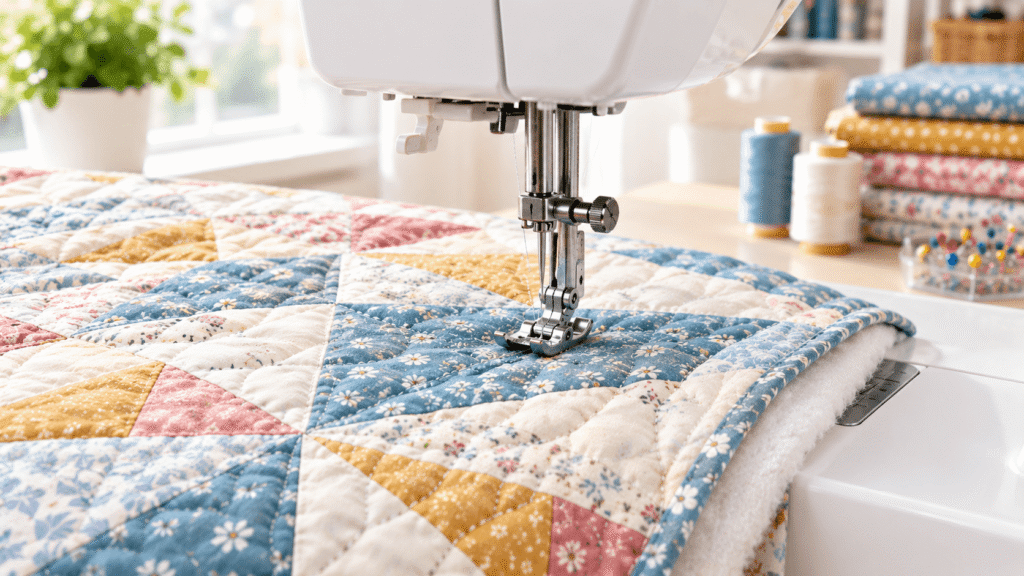
Quilting uses two different jobs, and each one wants a slightly different needle.
Piecing the top: Use an 80/12 universal or a 75/11 quilting needle. You’re only sewing through two layers of cotton, so a medium needle is plenty.
Machine quilting the sandwich: Use a 90/14 quilting needle. Now the needle has to pass through the quilt top, batting, and backing at once.
Quilting needles are built for this. They have an extra strong shaft and a tapered point that pass through several layers of woven fabric without shredding the thread.
Many sewists overlook thread here. If you quilt with a heavier 40-weight thread, a 90/14 gives the thread more room in the eye than an 80/12 would.
Needle Sizes for Knits, Silk, Linen, Fleece, and Leather
Not everything is woven cotton. Use this table when your project sits outside the cotton and denim ranges above.
| Fabric | Size | Needle Type | Note |
|---|---|---|---|
| Cotton jersey (T-shirts) | 70/10 to 80/12 | Ballpoint (Jersey) | Rounded tip slides between the loops |
| Spandex and activewear | 75/11 to 90/14 | Stretch | Helps prevent skipped stitches |
| Chiffon, silk, organza | 60/8 to 70/10 | Microtex (Sharp) | Fine point leaves tiny holes |
| Linen | 80/12 to 90/14 | Universal | Go to 90/14 for heavier linen |
| Fleece | 90/14 | Ballpoint or Universal | Ballpoint if it’s a knit fleece |
| Corduroy and twill | 90/14 | Universal | Moves to 100/16 for thick twill |
| Faux leather and vinyl | 90/14 to 100/16 | Leather (wedge point) | Cuts a clean hole |
| Leather | 90/14 to 110/18 | Leather | Choose size by thickness |
| Upholstery and canvas | 100/16 to 110/18 | Jeans/Denim | Sew slowly through seams |
Take a jersey T-shirt sewn with a universal needle. You’ll often get skipped stitches, and a ballpoint or stretch needle in the same size fixes it because it pushes the knit loops aside instead of cutting them.
What Size Sewing Machine Needle for Common Projects? (Cheat Sheet)
Sometimes you know the project but not the fabric name. Use this cheat sheet to go straight from project to needle.
| Project | Needle Size | Needle Type |
|---|---|---|
| Quilt piecing | 80/12 | Universal or Quilting (75/11) |
| Machine quilting (three layers) | 90/14 | Quilting |
| Hemming jeans | 100/16 | Jeans/Denim |
| Canvas tote bag | 100/16 | Jeans/Denim |
| Pillow covers in cotton or linen | 80/12 to 90/14 | Universal |
| Cotton T-shirt | 70/10 to 80/12 | Ballpoint (Jersey) |
| Leggings or swimwear | 75/11 to 90/14 | Stretch |
| Lined curtains in home-decor cotton | 90/14 | Universal |
| Sheer curtains or a chiffon scarf | 60/8 to 70/10 | Microtex |
| Faux leather bag | 90/14 to 100/16 | Leather |
Take a canvas tote with webbing straps. The body sews easily with a 100/16 jeans needle, but the strap ends stack several layers, so slow down there and turn the hand wheel through the thickest point.
Match Your Needle Size to Your Thread
Needle size isn’t only about fabric. Thread has to pass through the eye smoothly, or it fuzzes, shreds, and snaps.
A good rule is that the thread should fill roughly 70% of the eye. Too tight and the thread frays. Too loose and the stitch quality suffers.
Use these as starting points, and always test on a scrap of your real fabric first.
| Thread | Typical Use | Starting Needle |
|---|---|---|
| 60-weight (fine) | Lightweight fabrics, fine hems | 70/10 |
| 50-weight cotton or all-purpose polyester | Piecing, everyday garments | 80/12 |
| 40-weight | Machine quilting, heavier garments | 90/14 |
| 30-weight or topstitching thread | Jeans topstitching, decorative stitching | Topstitch 90/14 to 100/16 |
Topstitch needles are worth knowing about. They have an extra-large eye, so an 80/12 topstitch needle can carry thread that would jam in a standard needle of the same size.
If your thread keeps snapping, the needle may be only part of the story. Our guide on why a sewing machine thread keeps breaking covers tension and threading causes. And if you’re rethreading after a needle swap, here’s how to thread a sewing machine needle step by step.
How to Read the Size on Your Needle
Needle packs print two numbers, such as 90/14. The European size comes first and the American size second, and both describe the same needle.
You’ll also see the word “universal” on many packs. That word describes the shank shape that fits most home machines, not a one-size-fits-all point. Our guide on whether sewing machine needles are universal explains the difference.
For a full breakdown of the numbers, see what sewing machine needle numbers mean.
Signs You’re Using the Wrong Size
Your machine usually tells you before the needle breaks.
Needle too fine for the fabric:
- Needle bends or snaps in thick areas
- Skipped stitches on heavy or dense fabric
- Thread shredding or fraying at the eye
Needle too thick for the fabric:
- Visible holes along the seam line
- Puckering on lightweight fabric
- Snags or runs in delicate cloth
A quick way to check is to sew a short test seam on a scrap folded to match your real layers. Look for skipped stitches, visible holes, and puckering before you commit to the project.
Once you know the right size, swapping it takes under two minutes. Follow our guide on how to change a sewing machine needle so it goes in the correct way.
Common Mistakes to Avoid
- Using one size for every project, usually whatever came installed in the machine
- Choosing a bigger needle “to be safe” on delicate fabric, which leaves permanent holes
- Using a universal needle on knits instead of a ballpoint or stretch needle
- Ignoring thread weight when picking a size
- Sewing through thick seams at full speed with a small needle
- Reusing the same needle across very different fabrics without checking it
FAQs
What is the most common sewing machine needle size?
The most common sizes are 80/12 and 70/10. An 80/12 universal handles most medium-weight woven fabrics, while a 70/10 suits lighter cotton and linings. Many sewists keep both on hand, plus a 90/14 for heavier fabric, so a size change never means stopping a project.
Can I use an 80/12 needle for everything?
You can use it for a lot, but not everything. It’s a great default for quilting cotton and shirting. It will struggle with denim and canvas, and it’s too coarse for chiffon and fine silk. Match the size to your fabric weight.
What size needle should I use to hem jeans?
Use a 100/16 jeans needle for standard denim, and a 90/14 for lighter denim. For raw or very thick denim, a 110/18 helps. Slow down over side seams, since that’s where the layers stack up and needles snap most often. Turn the hand wheel through the thickest spot if needed.
Does thread weight change the needle size I need?
Yes. Thread has to fit the eye easily, so thicker thread needs a larger needle or a topstitch needle with a bigger eye. A fine 60-weight thread works with a 70/10, while a 40-weight thread usually wants a 90/14. Test on a scrap if you’re unsure.
Is a bigger needle better for thick fabric?
Not always. A larger needle pierces thick fabric more easily, but it also leaves bigger holes and can distort the stitch. Pick the smallest needle that sews the fabric cleanly, and choose a jeans or leather needle when the fabric needs a special point shape.
What size needle do I need for machine quilting?
For quilting through the top, batting, and backing, a 90/14 quilting needle is a reliable choice. For piecing only two layers of cotton, an 80/12 universal or a 75/11 quilting needle works well. Switch needles between the two jobs if your machine struggles.
How do I know if my needle size is wrong?
Skipped stitches, snapping needles, and shredded thread usually mean the needle is too fine or the wrong type. Visible holes and puckering on delicate fabric usually mean it’s too thick. Run a short test seam on a scrap folded to match your layers before sewing the real project.
Conclusion
Once you know what size sewing machine needle suits your fabric and thread, most stitching problems stop before they start. Keep the chart handy, start with an 80/12 when you’re unsure, and step up or down based on fabric weight, thread, and layers.
Fresh needles matter as much as the right size, so replace yours at the start of every new project. For the full process, see how to insert a sewing machine needle correctly.
Planning your next project? Use the Fabric Yardage Calculator to work out exactly how much fabric you need before you start cutting.