
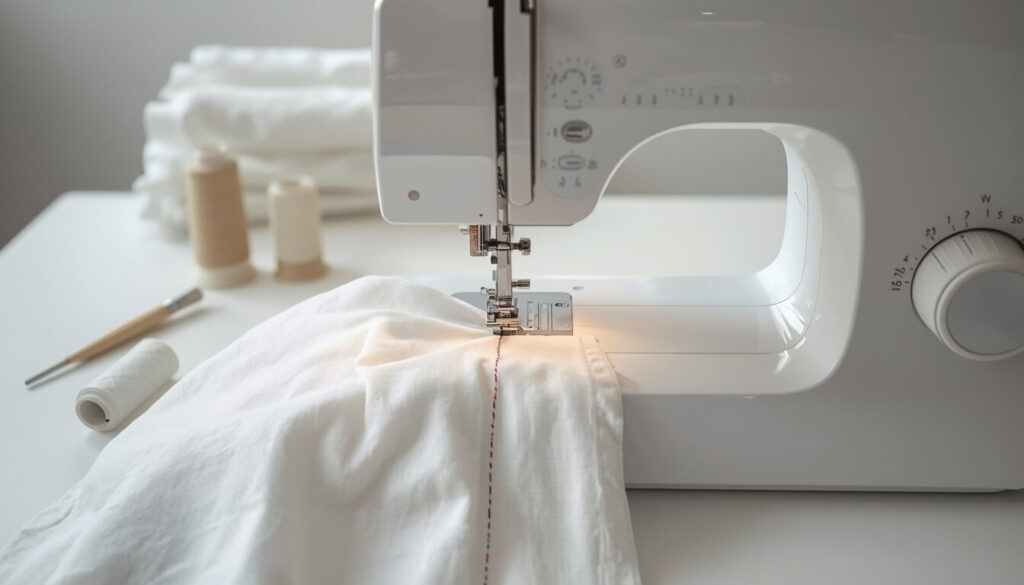
What tension should my sewing machine be on? For most everyday sewing, the answer is the default setting, which is often 4 on a 0 to 9 dial. From there, small changes of one number or less handle different fabrics, threads, and stitches.
You’ve probably noticed that tension charts online give wildly different numbers. This guide explains why, then gives you a starting-settings chart built on “start here, then nudge” instead of numbers that only work on one machine.
Table of Contents
Quick Answer
What tension should my sewing machine be on? Start at your machine’s default, usually around 4 on a 0 to 9 dial. That suits medium-weight cotton and standard thread.
Then nudge it. Go slightly lower for thin fabric, zigzag stitches, knits, and metallic thread. Go slightly higher for thick, layered fabric if loops appear underneath. Always test on a scrap of your real fabric first.
Why Tension Charts Disagree (And How to Use This One)
Search for a tension chart and you’ll find denim at 2.5, 4, and 8 on different pages. They aren’t all wrong. They’re written for different machines.
A dial that runs 0 to 9 on one brand may run 1 to 10 on another, and some machines show tension on a screen or set it automatically. A “4” doesn’t mean the same pull on every machine.
Thread matters too. According to Superior Threads, machines are factory preset to make even stitches with 50 or 60 weight thread. If the top and bobbin threads match in fiber and weight, you may not need to change anything. If they don’t match, adjustment becomes necessary.
Take two sewists stitching the same pair of jeans. One has a mechanical dial and the other an automatic machine. A chart that says “denim: 6” helps neither of them.
So this chart works differently. It gives you a starting point and a direction, and you confirm it with a test seam.
What Tension Should My Sewing Machine Be On? Starting Settings Chart
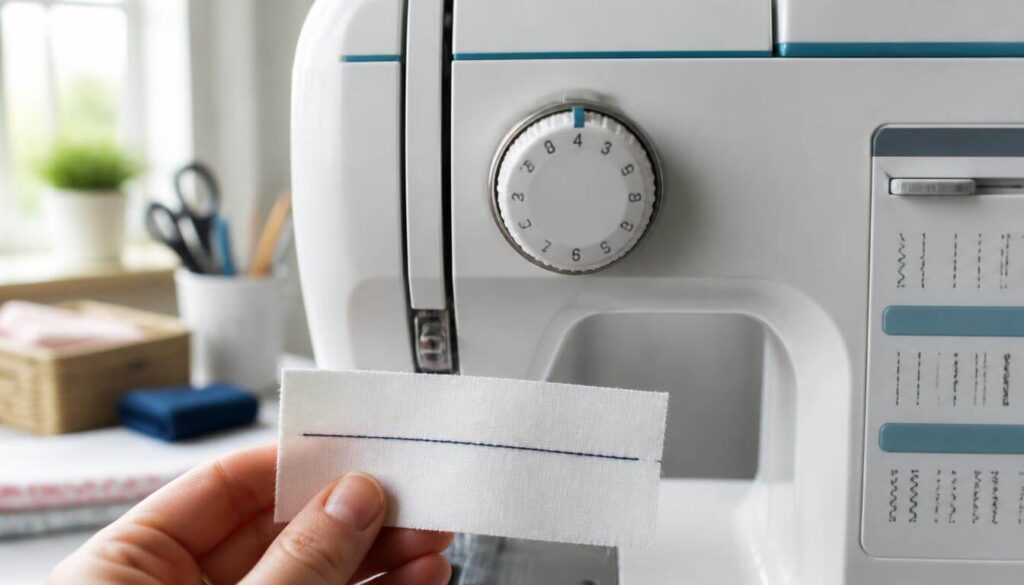
A “nudge” below means one number on your dial, or half a number if your dial has half marks. Use it as a first guess, then test.
| Situation | Start At | Then Adjust |
|---|---|---|
| Medium-weight cotton, linen, quilting cotton, 50 wt thread | Default (often 4) | Usually none; fine-tune by half a number |
| Lightweight fabric (chiffon, silk, lawn) | Default | Lower by about half to one if the seam puckers |
| Denim, canvas, upholstery | Default | Raise by about one if loops show underneath; lower if the seam puckers |
| Knits and stretch fabric | Default | Lower by about half to one if the seam tunnels or ripples |
| Zigzag and decorative stitches | Default | Lower by about one |
| Metallic thread on top | Default | Lower noticeably, to very loose, and slow down |
| Heavy topstitching thread on top | Default | Usually a little looser; test and adjust |
| Different top and bobbin thread weights | Default | Adjust from the test seam, expecting a small change |
For the exact steps to turn the dial and read the stitch, see our guide on how to adjust sewing machine tension.
Tension Settings by Fabric

What tension should my sewing machine be on when the fabric changes? Weight and weave decide how much friction the thread meets, so each fabric group below needs a slightly different nudge.
Lightweight Fabrics (Chiffon, Silk, Lawn)
Thin fabric can’t resist a hard-pulling thread, so seams pucker easily. Start at the default, then lower by half a number if the seam gathers.
Pair the tension change with a fine needle, around 60/8 to 70/10, and a finer thread. Our guide on what size sewing machine needle to use shows the right match.
Picture a chiffon scarf hem that ripples after sewing. A lighter needle and a half-number drop usually flatten it, with no other change.
Medium-Weight Cotton, Linen, and Quilting Cotton
This is where default tension was designed to work. Standard 50 weight cotton or polyester thread, an 80/12 needle, and a default setting give balanced stitches on most quilting cotton and shirting.
If you sew these fabrics most of the time, leave the dial alone and only make small changes when the project calls for it.
Denim, Jeans, Canvas, and Upholstery
Thick, layered fabric makes it harder for the top thread to pull the bobbin thread up into the middle of the seam. Start at the default and test across all the layers you’ll really sew, including side seams.
If loops appear underneath, raise the top tension by about one. If the seam puckers and the top thread looks tight, lower it slightly.
A real example is hemming jeans, where a seam can jump from two layers to four at the side seam. Test across that thick spot before you sew the whole hem. Our guide on how to hem jeans with a sewing machine shows the full method, and the needle should be a 100/16 for standard denim.
Knits and Stretch Fabric
Knits stretch as they feed, so a tight top thread pulls the seam into waves or ripples. Start at default and lower by half a number to one if the seam tunnels.
Use a ballpoint or stretch needle too. Skipped stitches on knits are often a needle problem, not a tension problem. For a full method, see our guide on how to sew stretch fabric on a sewing machine.
Tension Settings by Thread
What tension should my sewing machine be on when the thread isn’t standard? Thread changes the friction through the discs, so it often matters more than the fabric.
- Matching top and bobbin thread: Same fiber and same weight usually means no change from default.
- Mismatched threads: Cotton on top with polyester underneath, or a heavy thread over a fine bobbin thread, needs a small adjustment. Test and nudge.
- Metallic thread: It’s weaker and fussier than polyester. Superior Threads notes it needs very loose top tension. Slow down, and use a needle with a larger eye.
- Heavy topstitching thread: It drags more through the discs, so the top setting usually needs to be slightly looser. A topstitch needle, with its larger eye, helps the thread flow.
If your thread breaks or shreds rather than just looking uneven, tension may not be the cause. Read why your sewing machine thread keeps breaking next.
Tension Settings by Stitch Type
What tension should my sewing machine be on for different stitches? A straight stitch is the baseline, so default tension usually suits it. Other stitches pull the fabric differently.
A zigzag stitch swings side to side and draws the fabric inward more than a straight stitch does. Lower the top tension by about one if the fabric bunches or tunnels under the stitching.
Decorative stitches work the same way. They pack more thread into a small area, so a slightly looser top thread helps them lie flat.
Many computerized machines adjust tension automatically for each stitch. If yours does, treat the on-screen number as a fine-tuning tool, and only change it when a test seam shows a problem.
How to Check That Your Setting Is Right
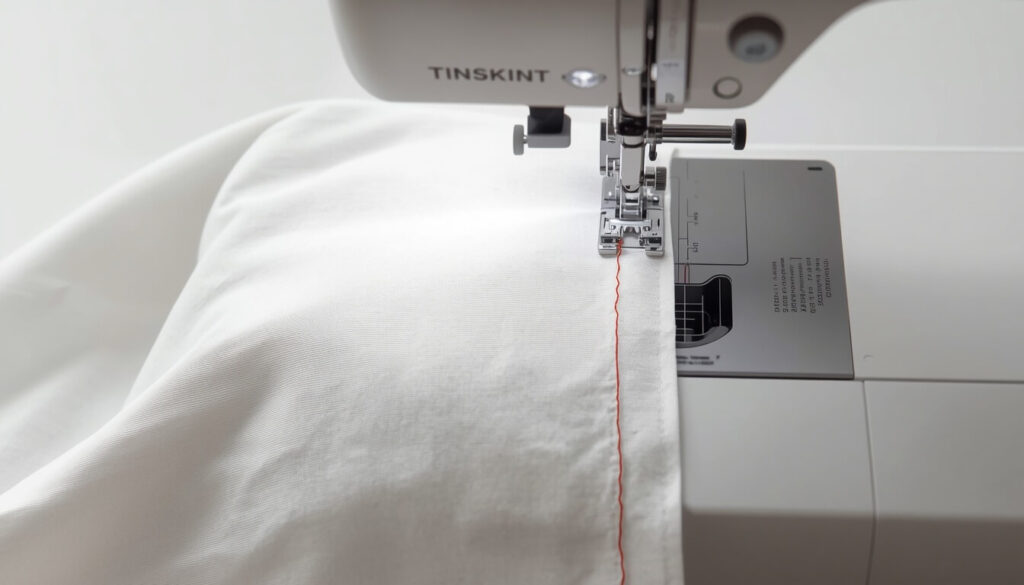
What tension should my sewing machine be on for your real fabric? A quick way to check is to sew a test seam on a scrap of it, through the same layers, with the same thread. Use one color on top and a different color in the bobbin.
Look at both sides. A balanced stitch looks the same on the front and back, with no loops, no bobbin thread showing on top, and no puckering.
If it’s off, follow the steps in our guide on how to adjust sewing machine tension. If the problem doesn’t respond to the dial, our guide on how to fix sewing machine tension covers the causes that aren’t tension at all.
Keep a Tension Log
Many sewists overlook how much time this saves. Once you’ve answered “what tension should my sewing machine be on” for a fabric and thread, write the answer down.
A small notebook or a note taped inside the machine lid works well. Record the fabric, thread, needle size, stitch, and the tension number. Next time you sew the same combination, you start from a setting you already trust.
When you finish the project, return the dial to its default so the next one starts from a clean baseline.
Common Mistakes to Avoid
- Copying a number from a chart without testing on your own machine
- Changing the dial before rethreading and checking the needle
- Making big jumps instead of half-number or one-number changes
- Testing on a different fabric than the one you’re sewing
- Forgetting to test across the thickest layers on denim and canvas
- Leaving the dial on a special setting after the project is done
- Blaming tension for problems that come from the needle or the thread
FAQs
Is 4 the right tension for a sewing machine?
For many machines, 4 is the default and works well for medium-weight fabric with standard thread. It isn’t universal, because dials differ by brand and some machines set tension automatically. Treat your machine’s default as the baseline, test on a scrap, and nudge from there.
What tension should I use for denim?
There’s no single number, because dial scales differ. Start at your default, test across every layer you’ll sew, and raise the top tension by about one if loops show underneath. Lower it slightly if the seam puckers. Use a 100/16 denim needle for standard denim.
What tension should I use for a zigzag stitch?
Start at the default, then lower the top tension by about one if the fabric bunches or tunnels under the stitching. Zigzag pulls the fabric inward more than straight stitching does, so a slightly looser top thread usually gives a flatter, more even result.
What tension should I use for metallic thread?
Metallic thread needs a very loose top tension, much looser than standard thread. Lower the dial noticeably, slow your sewing speed, and use a needle with a large eye. Test on a scrap, because metallic threads vary a lot between brands.
Why do tension charts give different numbers?
Machines have different dial scales, some have automatic tension, and threads vary. A chart written for one machine and one thread can mislead on another. Use charts as a direction, not an exact number, and always confirm with a test seam.
Do I need to change tension for every fabric?
No. Medium-weight woven fabric usually sews well at the default. You mostly adjust for thin fabric, thick layered fabric, knits, metallic or heavy thread, and zigzag or decorative stitches. Test any time you change fabric or thread, and reset the dial afterward.
What tension should I use for knit or stretch fabric?
Start at the default and lower the top tension by about half a number to one if the seam ripples or tunnels. Use a ballpoint or stretch needle as well, because the wrong needle can cause skipped stitches that look like a tension problem.
What tension should my sewing machine be on if the top and bobbin threads are different?
Start at the default and sew a two-color test seam. Mismatched fiber or weight, such as cotton on top and polyester in the bobbin, usually needs only a small adjustment. Change one number at a time until both sides match.
Conclusion
So, what tension should my sewing machine be on? Start at the default, treat every chart as a direction instead of a rule, and let a test seam on your real fabric make the final call.
Once you’ve found a setting that works, write it down and return the dial to default afterward. If the stitches still look wrong, the guides below cover the next likely cause.
Related articles