
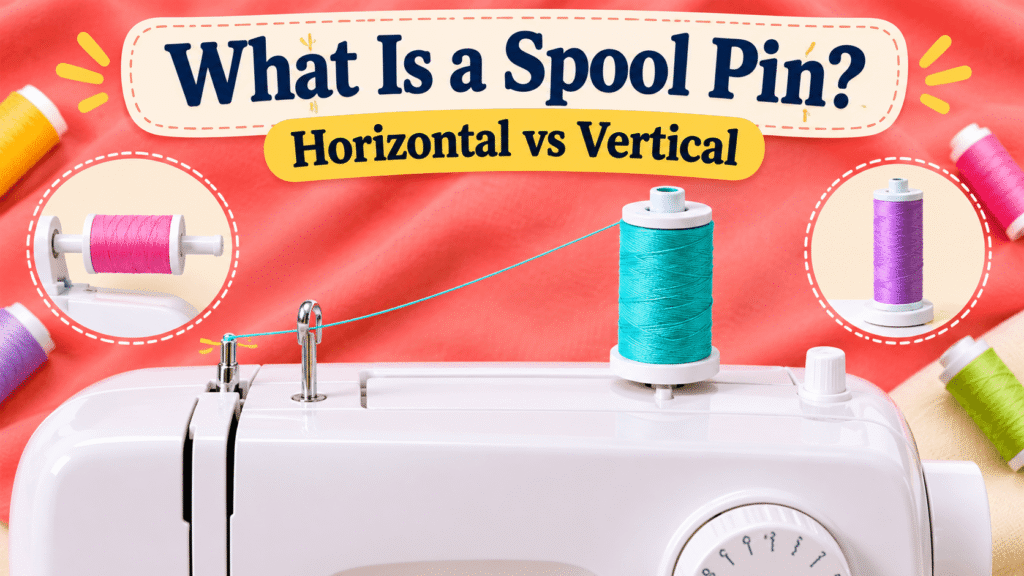
What is a spool pin? It is the small rod on top of your sewing machine that holds the spool of thread. Every stitch starts here, because the thread leaves the spool, travels through the machine, and ends up in the needle.
It looks like the simplest part on the machine, yet a poorly set spool can cause snagging, jumping thread and strange tension problems. This guide explains the two pin styles, how spool caps work, and how to set up different thread types. The spool pin is one of the first parts of a sewing machine you use every time you sew.
Table of Contents
Quick Answer: What Does a Spool Pin Do?
A spool pin holds your thread spool in place and lets the thread unwind smoothly as the machine pulls it. Pins come in two styles: horizontal, where the spool lies on its side, and vertical, where the spool stands upright. A spool cap on top keeps the spool from wobbling or sliding off.
Where Is the Spool Pin on a Sewing Machine?
Look at the top of the machine, usually at the back right. You will see a short rod that sticks out sideways (horizontal) or straight up (vertical). Some machines have both.
A second, smaller pin often sits nearby. It holds another spool, which is handy for winding a bobbin from a different thread, or for sewing with a twin needle. The steps for winding are in how to wind a bobbin.
All lockstitch machines draw the top thread from a spool in this way. Wikipedia’s sewing machine overview gives the wider background on how the thread is used.
Horizontal vs Vertical Spool Pins

| Feature | Horizontal pin | Vertical pin |
|---|---|---|
| Spool position | Lies on its side | Stands upright |
| How the thread comes off | The spool rotates as thread unwinds | The spool stays still, thread lifts off the top |
| Best for | Standard small spools | Cones, large spools and slippery threads |
| Needs a spool cap | Yes, almost always | Often uses a felt pad and a cap or stand |
| Common problem | Thread catches on the notch or cap | Thread can twist or loop as it lifts off |
A quick way to think about it is this: horizontal pins let the spool turn like a roll of tape, and vertical pins hold the spool still while the thread floats up and over the top. Both work. The right one depends on the thread.
Spool Caps and Felt Pads
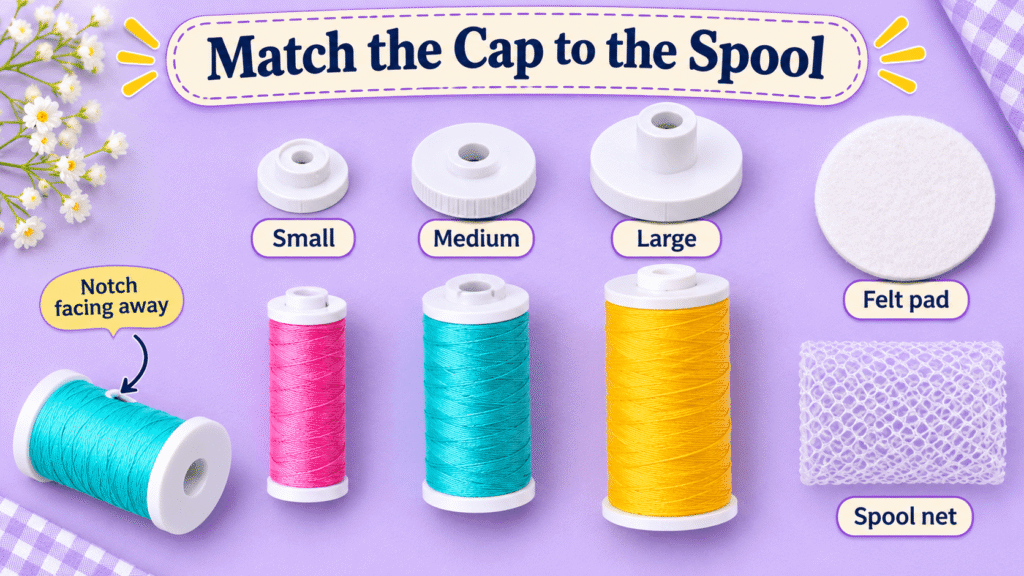
The spool cap is the round piece that slides onto the pin and presses lightly on the spool’s end. Its job is to stop the spool from sliding off and wobbling.
Most machines come with caps in two or three sizes. The cap should be slightly bigger than the end of the spool, and it should touch the spool lightly, not tightly. If the cap is too small, thread can slip between the cap and the spool and get caught. If it is pressed too hard, the spool cannot turn and the thread pulls tight.
Some machines also include a small felt pad under a vertical spool. The pad adds light friction so the spool does not overspin and spill extra thread.
Spool Pin Setup for Different Thread Types
| Thread type | Suggested setup | Why |
|---|---|---|
| Standard cotton or polyester spool | Horizontal pin with a matching cap | Unwinds easily and stays stable |
| Cone thread (serger or large cone) | Vertical pin, a cone holder or a thread stand | The cone is too wide for a small pin |
| Slippery thread (rayon, metallic) | Vertical pin or a thread stand, with a spool net if needed | The spool stays still, so loops are less likely |
| Very thin thread | Horizontal pin with a snug cap | Prevents wobble that causes snags |
For example, if you are using a large cone of polyester thread on a horizontal pin, it will often wobble and drag. Moving it to a thread stand behind the machine usually fixes the problem.
Real Example: Thread Keeps Jumping Off the Spool
Imagine you start a seam and the thread snaps after a few stitches. You rethread, try again, and it snaps once more.
Before assuming your machine is broken, look at the spool. Many spools have a small notch near one end, made to hold the thread tail. If that notch faces the thread’s path, the thread can catch inside it and tug. Turn the spool so the notch is away from the pull, or slide a spool net over the thread. Then check the cap. If it is smaller than the spool’s end, switch to a larger one.
If the thread still breaks, see why your thread keeps breaking for the other causes.
Step-by-Step: How to Set Up a Spool on a Spool Pin
- Raise the presser foot lever and turn off the machine.
- Choose the pin. Use horizontal for regular spools and vertical for cones or slippery thread.
- Slide the spool onto the pin. For a horizontal pin, the thread should leave the spool from the front, so it unwinds toward you. Check your manual for the direction on your model.
- Fit the right cap. Pick one slightly larger than the spool end and push it on until it touches lightly.
- Leave a little gap. The spool should spin freely with a gentle tug.
- Pull the thread to the first guide and continue to the needle. The full path is in how to thread a sewing machine needle.
- Sew a test seam on scrap fabric to check that the thread feeds smoothly.
Quick Troubleshooting Checklist: Spool Pin Problems
| Symptom | Likely cause | What to try |
|---|---|---|
| Thread jumps off the spool | Cap too small or missing | Fit a bigger cap |
| Thread snags near the spool end | Notch catching thread | Turn the spool or use a net |
| Spool wobbles while sewing | Pin loose or cap too small | Use a snug cap, check the pin |
| Thread is pulled tight | Cap pressing too hard | Back the cap off slightly |
| Thread loops or twists | Slippery thread on a spinning spool | Switch to a vertical pin or stand |
| Cone will not fit | Spool too large for the pin | Use a cone holder or stand |
If the problem continues, the cause may be farther down the thread path. A look at the tension discs is a good next step.
Helpful Tips for Using a Spool Pin
- Keep a few caps in your accessory box, in different sizes.
- Use a thread stand for big cones. It is cheaper than fighting your machine.
- Buy quality thread. Cheap thread often sheds lint and frays at the spool.
- Store spools with the tail tucked into the notch so it does not unravel.
- Wipe the pin occasionally. Lint and thread dust can stick to it.
Common Mistakes With Spool Pins
- Using the wrong cap size. Too small lets thread slip, too tight stops the spool.
- Putting a cone on a small pin. It wobbles and drags.
- Ignoring the notch. A notch facing the thread is a common snag point.
- Pulling thread off a spinning spool by hand, which adds extra loops.
- Blaming tension first. A bad spool setup often looks like a tension problem. The guide to how to fix sewing machine tension explains the right order of checks.
When to Call a Professional
Spool pin trouble rarely needs a technician. See one if the pin itself is bent, loose in its socket, or has broken off. A damaged pin can be replaced, but the part must match your machine’s model.
FAQs
What is a spool pin on a sewing machine?
A spool pin is the small rod on top of your machine that holds the thread spool. It keeps the thread steady as the machine pulls it through the guides. Pins are either horizontal or vertical, depending on the machine.
What is the difference between a horizontal and vertical spool pin?
On a horizontal pin, the spool lies on its side and turns as thread unwinds. On a vertical pin, the spool stands upright and stays still while thread lifts off the top. Vertical pins often suit cones and slippery thread better.
What is a spool cap for?
A spool cap holds the spool in place on the pin and keeps it from wobbling or sliding off. It should be slightly larger than the spool end and touch it lightly. A cap that is too small can let thread get caught.
Do I need a thread stand?
Not always. A thread stand helps with large cones and slippery thread that do not fit a standard spool pin well. If your thread unwinds smoothly on your machine’s pin, you do not need one.
Why does my thread keep getting caught on the spool pin?
The most common causes are a spool notch facing the thread, a cap that is too small, or a spool that wobbles. Turn the spool, switch to a better cap, or try a vertical pin or thread net to fix it.
Can I use any spool on any spool pin?
Most standard spools fit, but very large cones and wide spools may not. Use the largest cap that fits, or move to a cone holder or stand. Always check that the spool turns freely.
Conclusion
So, what is a spool pin? It is the small rod that holds your thread, and getting it right keeps every stitch feeding smoothly. Match the pin style to your thread, use a cap that fits, and watch the notch. A few seconds of setup can save a lot of tangled thread.
For the bigger picture, see the full guide to the parts of a sewing machine.
With the thread set up, plan your next project with the fabric yardage calculator so you buy only what you need.