
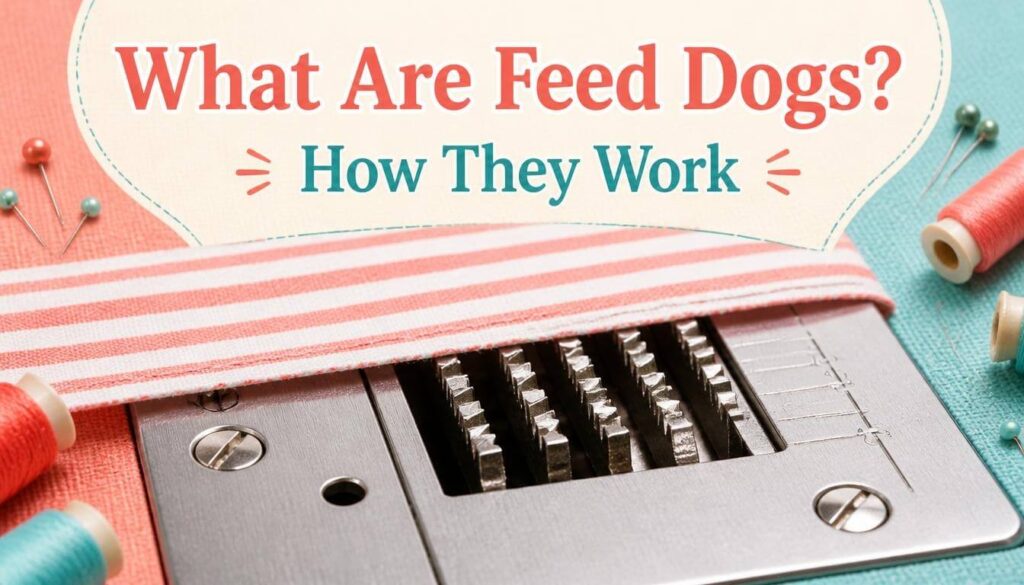
What are feed dogs on a sewing machine? They are the rows of small metal teeth that poke up through the plate under your needle and pull the fabric along as you sew. You never push the cloth yourself, because the feed dogs do the moving.
They are easy to ignore until something goes wrong. If your fabric suddenly refuses to budge, or your stitches turn into a tight knot in one spot, the feed dogs are usually part of the story. This guide explains what they do, how they move, when to lower them, and how to keep them working. They are one of the most important parts of a sewing machine.
Table of Contents
Quick Answer: What Do Feed Dogs Do?
Feed dogs grip the underside of your fabric and move it a small step backward after every stitch. The presser foot holds the cloth against the teeth from above. Together they pull the fabric away from you at an even pace, which keeps stitches the same length.
What Are Feed Dogs and Where Are They?
Look down at the metal plate directly under the needle. Two or more narrow slots hold rows of tiny ridged teeth. Those teeth are the feed dogs. The plate itself is the throat plate, sometimes called the needle plate.
The teeth can rise above the plate or sink below it. When they are up, they press into the fabric. When they are down, the fabric slides freely. Wikipedia’s feed dog entry describes them as a movable part that pulls fabric through the machine in separate steps between stitches.
How Feed Dogs Move: The Four-Step Cycle

Feed dogs do not just go back and forth. They follow a small loop, which is called a four-motion feed. That design dates back to an 1854 US patent, as the Wikipedia entry notes.
Here is what happens during one stitch:
- Rise. The teeth lift through the slots and press the fabric against the presser foot.
- Pull. They slide backward, carrying the cloth with them.
- Drop. They sink below the plate so the cloth is free for a moment.
- Return. They slide forward, ready for the next stitch.
The needle enters the fabric during the drop and return steps, when the cloth is not moving. That timing is why the fabric glides without the needle bending.
To see how this timing connects to the needle, hook and bobbin, how a sewing machine works shows the full stitch sequence.
Feed Dogs and Stitch Length
The stitch length dial tells the feed dogs how far to move in each cycle. A longer stitch means a bigger step.
| Stitch length | What happens | Good for |
|---|---|---|
| 1.5 mm | Small steps, tight stitches | Fine fabrics, curves |
| 2.5 mm | Medium steps | Everyday seams |
| 4 mm | Long steps | Basting, gathering, topstitching |
A quick example: you set the length to 4 mm for basting, and the fabric moves along twice as fast as it did at 2 mm. If your stitches look uneven when you try to sew slowly, check the dial before blaming the machine.
Types of Feed Dogs
Not all feed dogs look the same. Your machine’s style depends on its age and price.
| Type | What it is | Where you see it |
|---|---|---|
| Standard feed dogs | Two or three short rows of teeth | Basic and older home machines |
| Wider multi-row feed dogs | Several rows, often described as seven-piece | Many modern machines. Better grip on slippery cloth. |
| Dual or even feed | Extra top feed system built into the machine or foot | Higher-end machines or add-on feet |
For layers that still creep, such as quilts, a walking foot adds a second set of top teeth. That is covered in what is a walking foot.
Drop Feed: When to Lower the Feed Dogs

Most machines have a small switch or button, often on the back or underside of the bed, that lowers the teeth. This is the drop-feed lever.
Lower the feed dogs when you want to control the fabric yourself:
- Free-motion quilting or darning, where you move the cloth in any direction
- Sewing on buttons with a zigzag stitch
- Monogramming or free-hand decoration
For free-motion work you also use a darning foot, which is one of the feet in what is a presser foot.
A common stumbling block is forgetting to raise them afterward.
Real Example: The Machine That Suddenly Stopped Feeding
Imagine you spent Saturday doing free-motion quilting. On Sunday you sit down to hem a pair of curtains. The needle goes up and down, but the fabric will not move, and the stitches pile up in one spot.
Before assuming your machine is broken, check the drop-feed lever. If it is still set to “down”, slide it back and try again. In most cases that is the whole problem. If the lever is correct and the cloth still does not move, work through why your machine is not feeding fabric.
Step-by-Step: How to Clean Feed Dogs

Lint builds up around the teeth and packs them flat. Cleaning takes about ten minutes. Check your manual for the exact steps on your model.
- Switch off and unplug the machine.
- Raise the needle and the presser foot lever, then remove the foot and the needle.
- Remove the throat plate. Most plates unscrew with a small screwdriver or slide off. See what is a throat plate.
- Brush out the lint from around the teeth and the bobbin area with the small brush from your accessory kit.
- Wipe the surfaces with a dry cloth. Avoid blowing compressed air into the machine, since it can push lint deeper.
- Replace the plate, needle and foot. Turn the hand wheel toward you by hand for one stitch to confirm everything moves freely.
Oil only if your manual says so. A full tune-up routine is in how to service a sewing machine.
Quick Troubleshooting Checklist: Feed Dog Problems
| Symptom | Likely cause | What to try |
|---|---|---|
| Fabric does not move | Feed dogs lowered | Slide the drop-feed lever back up |
| Stitches bunch in one spot | Feed dogs clogged with lint | Remove the plate and clean |
| Uneven stitch length | Stitch length dial too short or worn feed dogs | Reset the dial, test on scrap |
| Fabric drifts to one side | Presser foot pressure uneven | Check the foot is seated correctly |
| Layers shift against each other | Top layer is dragged | Try a walking foot |
| Teeth marks on delicate fabric | Pressure too heavy | Lower the pressure dial |
Helpful Tips for Feed Dogs
- Check the drop-feed lever first whenever fabric stops moving.
- Clean after every big project, especially fleece, flannel or felt, which shed lint fast.
- Use a fresh needle. Burrs and bent needles drag the cloth and look like feed problems.
- Do not pull the fabric. Let the teeth do the work. Guide, do not tug.
- Test on a scrap each time you change fabric type.
Common Mistakes With Feed Dogs
- Forgetting to raise the feed dogs after free-motion work.
- Pushing or pulling the fabric, which bends needles and breaks stitches.
- Skipping cleaning, so lint packs the teeth flat.
- Oiling feed dogs without checking the manual. Some machines need no oil there.
- Replacing the plate with the wrong one. Plates differ by model.
When to Call a Professional
See a technician if the feed dogs will not rise even after cleaning and the lever is correct, if the teeth are visibly worn smooth, or if you hear a clunk each time the teeth move. These usually point to a worn or misaligned feed mechanism under the bed. How to repair a sewing machine lists what is safe to try yourself first.
FAQs
What are feed dogs on a sewing machine?
Feed dogs are the small metal teeth under the needle plate that grip your fabric and move it backward after each stitch. They work with the presser foot, which holds the cloth down. This steady movement keeps stitches even and your seam straight.
Where are the feed dogs on a sewing machine?
They sit in slots in the throat plate, directly under the presser foot. When the foot is lifted you can see the rows of small teeth. On some machines you may need to remove the foot to see them clearly.
When should I lower the feed dogs?
Lower them for free-motion quilting, darning or any job where you want to move the fabric yourself. Raise them again for normal sewing. If the cloth will not move after a break from free-motion work, check the drop-feed lever first.
Why is my sewing machine not feeding fabric?
The most common causes are lowered feed dogs, lint pack ed between the teeth, a presser foot that is not pressing down, or a stitch length set to zero. Start with the drop-feed lever and a quick clean before looking at other parts.
Can feed dogs be replaced?
Yes, but the part must match your exact model. A technician can fit a new set if the teeth are worn flat. Cleaning and correct pressure solve most feeding problems, so replacement is rarely the first step.
How often should I clean the feed dogs?
A light brush after each large project is a good habit, and a full clean every few months for regular sewists. Heavy lint fabrics like fleece and flannel may call for cleaning sooner, since lint builds up quickly around the teeth.
Conclusion
So, what are feed dogs on a sewing machine? They are the small teeth that carry your fabric through every stitch, rising, pulling, dropping and returning in a steady loop. Keep them clean, remember to raise them after free-motion work, and let them move the cloth without your help.
If you want to see how they connect to every other piece, read the full guide to the parts of a sewing machine.
Once your fabric is feeding smoothly, plan your next project with the fabric yardage calculator before you cut.